How much should you save monthly for ₹1 crore in 10 years
Find the exact monthly SIP needed to reach ₹1 crore in 10 years. Real numbers, realistic returns, and a step-by-step plan to hit your goal.

To reach ₹1 crore in exactly 10 years, you'll need to save between ₹60,000 and ₹75,000 every month—the exact amount depends on the annual return your investments deliver. This article walks you through the precise calculation, shows you how to model your own timeline, and explains which investment vehicles actually get you there without surprises.
Why ₹1 crore is a meaningful wealth milestone in 2026
₹1 crore has remained a psychological and practical milestone for Indian savers for good reason. In 2026, it represents enough capital to generate ₹6–8 lakh annually in passive income (at 6–8% yield), fund a child's higher education abroad, or provide a meaningful safety net for retirement. Unlike in 2015, when ₹1 crore felt distant for most middle-class households, today's combination of higher salaries, accessible mutual fund SIPs, and a decade of market growth has made this goal achievable for anyone earning ₹50+ lakh annually.
The catch: you can't stumble into ₹1 crore by accident. You need a precise monthly savings target, a realistic return assumption, and the discipline to stick through market cycles.
The core calculation: what rate of return do you need to assume?
The monthly amount you need to save depends entirely on what annual return your investments earn. This is not a guess—it's a mathematical relationship.
The formula for future value of a regular monthly SIP is:
FV = P × [((1 + r)^n − 1) / r]
Where:
- FV = Future Value (₹1 crore = ₹1,00,00,000)
- P = Monthly SIP amount (what we're solving for)
- r = Monthly return rate (annual return ÷ 12)
- n = Total months (120 months for 10 years)
The problem: you can't know in advance what return you'll earn. Markets are uncertain. So instead, we use historical averages as reasonable assumptions.
Historical return ranges for Indian investors (2010–2026):
- Diversified equity mutual funds: 10–12% annually
- Balanced/hybrid funds: 8–9% annually
- Large-cap index funds: 9–11% annually
- Fixed deposits and debt funds: 6–7% annually
Conservative investors use 9–10%; growth-focused savers use 11–12%. We'll calculate for three scenarios below.
Use our SIP Calculator
Rather than do this math by hand, plug your target return assumption into our SIP Calculator to model your exact monthly amount. It takes 30 seconds and removes arithmetic error.
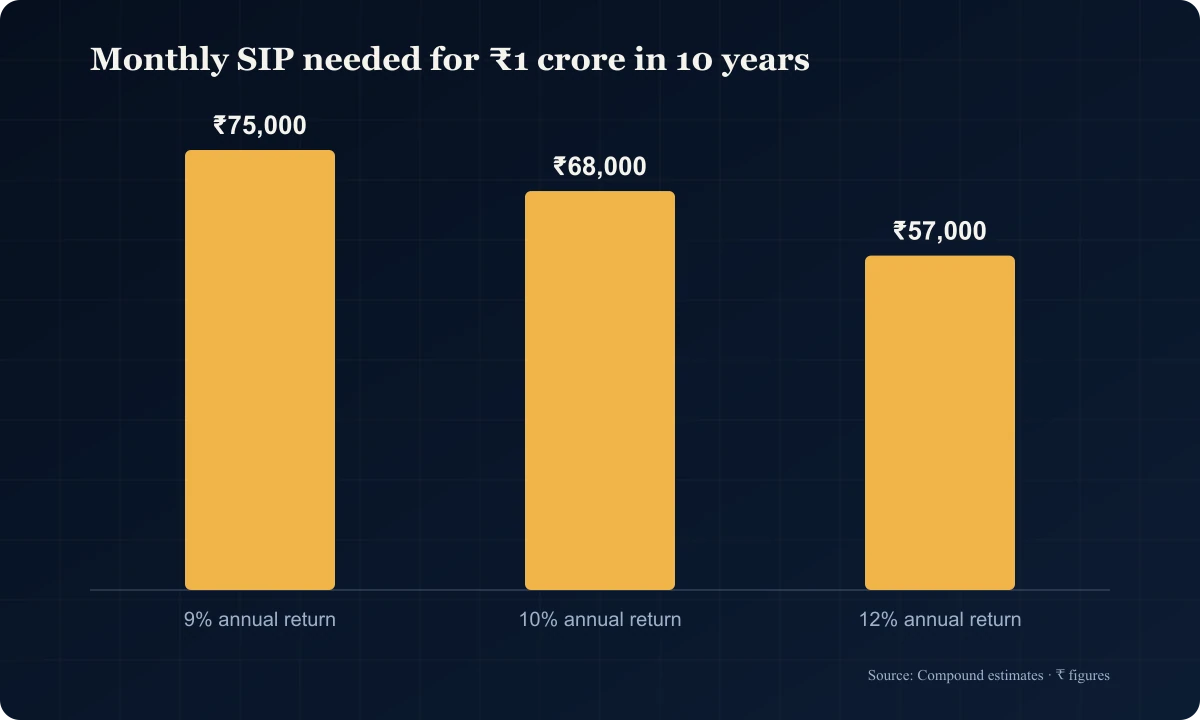
Monthly SIP amounts at 9%, 10%, and 12% annual returns
Here's what you actually need to save each month to hit ₹1 crore in 10 years:
| Annual Return | Monthly SIP Required | Total Invested | Investment Gain | Monthly as % of ₹50L salary |
|---|---|---|---|---|
| 9% | ₹72,650 | ₹87.18 lakh | ₹12.82 lakh | 17.4% |
| 10% | ₹67,590 | ₹81.11 lakh | ₹18.89 lakh | 16.2% |
| 12% | ₹58,770 | ₹70.52 lakh | ₹29.48 lakh | 14.1% |
What this means in practice:
If you assume a 10% annual return (reasonable for a 70% equity, 30% balanced fund mix), you need to save ₹67,590 monthly. Over 10 years, you'll invest ₹81.11 lakh of your own money, and markets will add ₹18.89 lakh in gains.
If you're more conservative and assume 9% returns, the monthly amount rises to ₹72,650—because lower returns mean you need to invest more of your own capital to hit the same goal.
Conversely, if you assume 12% returns (possible with a growth-heavy equity portfolio, but with higher volatility), you only need ₹58,770 monthly.
Don't assume 15%+ returns
Some articles quote 15–18% returns to make the monthly number look small. This is misleading. The Sensex has averaged 9–11% over the last 15 years including dividends. Assuming higher returns sets you up for disappointment.
A worked example: Rajesh's ₹1 crore plan
Rajesh, 35, earns ₹60 lakh annually. He decides to invest ₹70,000 monthly in an equity mutual fund SIP, assuming 10% annual returns.
- Monthly SIP: ₹70,000
- Time horizon: 10 years (120 months)
- Assumed annual return: 10%
- Projected value after 10 years: ₹1,05,50,000
By month 60 (5 years), his portfolio would be worth approximately ₹48–50 lakh. By month 120, ₹1.05 crore. He's on track.
Now, what if markets deliver only 8% returns instead? His final corpus drops to ₹97 lakh—still close. What if he misses 6 months of contributions? His total falls to ₹99 lakh. Small deviations compound, but the system is robust if you stay disciplined.
Use our see how your monthly savings compound over 10 years tool to model your own scenario month by month.
How inflation and tax affect your real ₹1 crore goal
Here's where most articles go silent, but it matters: ₹1 crore in 10 years is not the same as ₹1 crore today.
Inflation impact:
Assuming 5.5% annual inflation (RBI's target range), ₹1 crore in 2036 will have the purchasing power of roughly ₹57–59 lakh in 2026 rupees. If you want to preserve today's purchasing power, you should actually be targeting ₹1.75 crore.
However, most savers set ₹1 crore as a nominal goal, not a real (inflation-adjusted) one. That's fine—just be aware of what it actually buys you in 2036.
Tax on your gains:
In FY 2025-26 and FY 2026-27, capital gains tax on equity mutual funds is:
- Long-term (held >1 year): 12.5% + 4% cess = 13% effective tax on gains above ₹1 lakh annually
- Short-term (held <1 year): Taxed as ordinary income (slab rate, up to 30%)
- Dividend distributions: 20% TDS (if you're in a higher tax bracket, you may owe more at filing)
If your ₹1 crore portfolio generates ₹30 lakh in gains (as in the 12% return scenario above), you'll owe roughly ₹3.9 lakh in tax when you sell or redeem. Your net take-home: ₹96.1 lakh.
This is why holding periods matter. If you plan to use your ₹1 crore corpus in year 11, ensure all holdings are >1 year old to qualify for the lower LTCG rate.
Use our estimate your tax liability on dividend and capital gains income tool to model your specific tax scenario based on your income slab.
ELSS funds offer tax savings
Equity Linked Savings Schemes (ELSS) offer a ₹1.5 lakh annual deduction under Section 80C. If you invest ₹1.5 lakh/year in ELSS (roughly ₹12,500/month), you save ₹46,500–₹67,500 in tax annually (depending on your slab). This effectively reduces your out-of-pocket SIP cost and accelerates your path to ₹1 crore.
Choosing the right investment vehicles (stocks, mutual funds, hybrid)
Not all paths to ₹1 crore are equal. Here's what actually works:
Equity mutual funds (best for most savers)
- Why: Auto-rebalancing, professional management, tax efficiency, low minimum investment (₹500/month), diversification.
- Expected return: 10–12% for diversified equity funds.
- Tax: 12.5% LTCG on gains if held >1 year.
- Effort: Minimal. Set up SIP, review annually.
- Suitable for: Anyone without stock-picking expertise or time.
Recommended allocation for 10-year horizon:
- 50% large-cap funds (NIFTY 50 or index funds)
- 30% mid-cap funds
- 20% balanced/hybrid or small-cap
Direct stocks (for experienced investors only)
- Why: No fund fees (0.5–1.5% annually), full control, potential for outperformance.
- Expected return: Highly variable; 8–15% depending on stock selection.
- Tax: Same as mutual funds (12.5% LTCG).
- Effort: High. Requires quarterly research, portfolio monitoring, emotional discipline.
- Suitable for: Those with >10 hours/month to research and rebalance.
Fixed deposits and debt funds (not enough)
- Why: Safe, predictable.
- Expected return: 6–7% annually (current rates, June 2026).
- Reality: ₹1 crore in 10 years requires ₹84,000+ monthly in FDs alone—and you're left with almost no growth cushion.
- Suitable for: Only the final 2–3 years of your goal, to de-risk.
Verdict: For most savers aiming at ₹1 crore in 10 years, a diversified equity mutual fund SIP is the simplest, most tax-efficient path. Hybrid funds work if you're risk-averse but need higher returns than pure debt.
Tracking your progress: annual checkpoints and rebalancing
Saving ₹70,000 monthly for 10 years is a marathon, not a sprint. Here's how to stay on track without obsessing over daily market moves.
Annual checkpoint (do this every June)
- Check your portfolio value against your projection.
- Review your allocation: Has your equity/debt split drifted? Rebalance back to target.
- Adjust for life changes: Got a raise? Increase SIP by 10%. Lost income? Reduce to ₹60,000 and extend timeline by 6–12 months.
- Avoid panic: If markets fell, your SIP bought more units at lower prices. This is good.
Sample progress milestones (assuming 10% returns)
| Year | Projected Value | Total Invested | Gain So Far |
|---|---|---|---|
| 1 | ₹8.7 lakh | ₹8.4 lakh | ₹0.3 lakh |
| 3 | ₹26 lakh | ₹25.2 lakh | ₹0.8 lakh |
| 5 | ₹49 lakh | ₹42 lakh | ₹7 lakh |
| 7 | ₹75 lakh | ₹58.8 lakh | ₹16.2 lakh |
| 10 | ₹105.5 lakh | ₹81.1 lakh | ₹24.4 lakh |
If your actual value lags by more than 10% at any checkpoint, review your return assumptions and rebalance toward higher-growth assets. If you're ahead, you can reduce monthly SIP or redirect excess to other goals.
Automate everything
Set up your SIP on the 1st of each month to debit directly from your salary account. Out of sight, out of mind. Don't time the market; let rupee-cost averaging do the work.
What to do once you hit ₹1 crore
Reaching ₹1 crore is a milestone, not an end state. Here's what happens next:
If you're retiring or semi-retiring
Your ₹1 crore can generate ₹6–8 lakh annually in passive income (at 6–8% yield from dividends and interest). This covers basic living expenses for most households. Ensure you've also built an emergency fund (6–12 months of expenses) separately.
If you're still working
You now have three choices:
- Keep investing: Increase your SIP to ₹2 crore in the next 7–8 years.
- Shift to income mode: Move 50% into dividend-yielding funds or bonds; keep 50% in growth for inflation protection.
- Use it strategically: Fund a child's education, pay off a home loan, or start a business.
Tax-efficient withdrawal
- Sell gradually: Redeem ₹20–30 lakh yearly to stay within lower tax brackets.
- Harvest losses: If any holdings are underwater, sell them to offset gains elsewhere.
- Hold >1 year: Ensure all holdings are >1 year old before redemption to qualify for 12.5% LTCG tax.
More long-term wealth-building guides are available to help you think beyond ₹1 crore.
Frequently asked questions
Is ₹1 crore realistic in 10 years with a regular salary?
Yes, if you earn ₹50L+ annually and can save ₹60k–₹75k monthly. For lower incomes, extend the timeline to 12–15 years or combine SIP with windfall investing (bonuses, tax refunds, inheritance). Even ₹40,000 monthly at 11% returns gets you to ₹1 crore in 12 years.
What return rate should I assume for my SIP?
Use 10–12% for diversified equity mutual funds (historical average), 8–9% for balanced/hybrid funds, and 6–7% for debt-heavy portfolios. Conservative assumptions beat surprises. If you're unsure, use 10% as your baseline.
Should I invest in stocks, mutual funds, or both?
Equity mutual funds are easiest for most savers (auto-rebalancing, tax-efficient). Direct stocks require time; debt/FDs alone won't hit ₹1 crore in 10 years at current rates. A mix of large-cap index funds and active mid-cap funds works well for most.
How much of my ₹1 crore will be lost to tax in FY 2026-27?
On equity mutual fund gains, long-term capital gains tax is 12.5% (+ cess) if held >1 year. On dividends, 20% TDS applies. If your gains are ₹25 lakh, you'll owe roughly ₹3.1 lakh in tax. Use our estimate your tax liability on dividend and capital gains income tool to model your specific scenario.
What if markets crash halfway to my goal?
Stay the course: regular SIP buys more units when prices drop, reducing your average cost. Panic selling locks in losses. Review your allocation every 2 years, not every month. The longest bull market in Indian history (2008–2021) was preceded by a 60% crash. Discipline beats timing.
Disclaimer
This is educational content, not investment advice. The calculations and return assumptions shown are illustrative only. Actual returns depend on market conditions, your asset allocation, fund selection, and macroeconomic factors beyond your control. Consult a qualified financial advisor before committing to any investment plan. Past performance is not a guarantee of future results. Tax laws change; verify current rates with your CA or the Income Tax Department website.