Retirement corpus for ₹50,000 monthly income in India
Calculate the retirement corpus needed for ₹50,000 monthly income in India. Includes the 4% withdrawal rule, inflation adjustment, and SWP strategy for FY 20…
If you want a retirement corpus for ₹50,000 monthly income in India, you need a specific number — not vague "save more" advice. This article gives you the exact corpus math at three withdrawal rates, shows how inflation distorts your target, and lays out SWP and tax strategies for FY 2026-27 so you can act with confidence.
What retirement corpus do you need for ₹50,000 per month?
The math is straightforward once you break it down. ₹50,000 per month equals ₹6,00,000 per year. To generate that as withdrawal income without depleting your corpus too fast, you divide your annual need by a withdrawal rate.
Using the widely accepted 4% withdrawal rule:
- Annual income needed: ₹6,00,000
- Withdrawal rate: 4%
- Corpus required: ₹6,00,000 ÷ 0.04 = ₹1,50,00,000 (₹1.5 crore)
So the baseline retirement corpus for ₹50,000 monthly income in India is approximately ₹1.5 crore if you withdraw at 4% annually. This is the simplest answer to how much corpus needed to retire in India at this income level.
But this number is a starting point, not a finish line. The real corpus you need depends on three variables that move the number significantly:
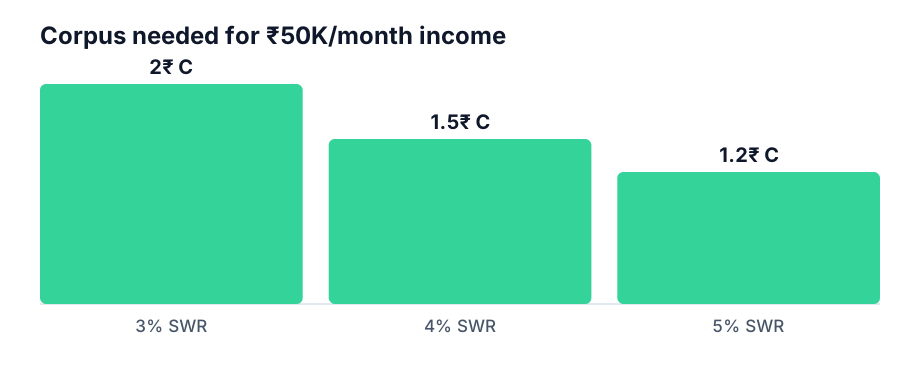
- Withdrawal rate — 3%, 4%, or 5% changes your corpus from ₹1.2 crore to ₹2 crore
- Inflation — ₹50,000 today will not buy the same goods in 15 years
- Life expectancy — retiring at 50 means funding 35+ years; retiring at 60 means funding 25
We will tackle each of these in the sections below.
The 4% safe withdrawal rule explained for Indian retirees
The 4% rule originated from the US-based Trinity Study (1998), which tested historical market data to find a withdrawal rate that survived 30-year retirement periods. The rule says: withdraw 4% of your starting corpus in year one, then adjust that amount for inflation each year. Historically, this portfolio — split between stocks and bonds — survived 95%+ of 30-year periods in US markets.
For India, the 4% rule needs careful adaptation. Three differences matter:
- Inflation is higher. US long-term inflation averages 2.5-3%. India's CPI inflation has averaged 5-6% over the last two decades. Your inflation-adjusted withdrawals rise faster, eating into the corpus sooner.
- Equity returns are more volatile. Indian equity has delivered roughly 12-13% CAGR over 20+ years, but with sharper drawdowns. Sequence-of-returns risk is real — a 30% market fall in the first two years of retirement can wreck a 4% plan even if long-term averages hold.
- Life expectancy is improving. A 60-year-old Indian retiree today has a meaningful chance of living to 85. A 30-year retirement is a reasonable planning horizon, and many readers may need 35 years.
This is why many Indian financial planners recommend a 3% safe withdrawal rate for retirement in India rather than 4%. The trade-off: a lower withdrawal rate means a larger corpus, but it gives you a wider margin against bad market years and longer lifespan.
Corpus needed at different withdrawal rates
Here is how your target corpus shifts at three withdrawal rates for ₹50,000 monthly income:
| Withdrawal rate | Annual income | Corpus required | Risk level |
|---|---|---|---|
| 3% (conservative) | ₹6,00,000 | ₹2,00,00,000 (₹2 crore) | Lower risk, suitable for 30-35 year retirement |
| 4% (standard) | ₹6,00,000 | ₹1,50,00,000 (₹1.5 crore) | Moderate risk, works for 25-30 year retirement |
| 5% (aggressive) | ₹6,00,000 | ₹1,20,00,000 (₹1.2 crore) | Higher risk, may deplete corpus in bad market years |
Which rate should you pick?
- Use 3% if you retire early (before 55), expect to live past 85, or want to leave a legacy corpus for your family.
- Use 4% if you retire around 60, have moderate expenses, and are comfortable with some market exposure for the corpus.
- Use 5% only if you have other income sources (rent, pension) supplementing the ₹50,000, or if you accept the risk of corpus depletion in later years.
The conservative 3% rate pushes your target to ₹2 crore. This is the number to aim for if you want a stress-free retirement. The 4% figure of ₹1.5 crore is acceptable if you have a pension or rental income as backup.
How inflation increases your retirement corpus requirement
This is where most retirement planning calculators in India mislead people. They assume ₹50,000 per month is a fixed target. It is not. Inflation means the ₹50,000 lifestyle you want today will cost far more in the future.
At 6% inflation (a realistic long-term India rate):
- ₹50,000 today = ₹89,500 per month in 10 years
- ₹50,000 today = ₹1,60,000 per month in 20 years
- ₹50,000 today = ₹2,87,000 per month in 30 years
If you are 35 years old today and plan to retire at 60, your ₹50,000 monthly need becomes approximately ₹2,15,000 per month by retirement. That means your corpus target is not ₹1.5 crore — it is much higher.
Two ways to handle inflation in your corpus plan
1. Plan for inflation-adjusted withdrawals. Your starting corpus needs to be large enough that you can withdraw more each year without running out. The 4% rule already accounts for this — you withdraw 4% in year one, then increase that rupee amount by inflation each year. But the math only works if your corpus earns enough above inflation (a real return of 2% or more).
2. Build a corpus that grows faster than withdrawals. If your corpus earns 9% and you withdraw 4% plus 6% inflation adjustment, the corpus still grows at roughly -1% real. That is the problem — you need either higher returns or a lower withdrawal rate.
For a 30-year retirement with 6% inflation and 4% withdrawals, a corpus of ₹1.5 crore invested at 9% return will last approximately 25-28 years, not forever. This is why the 3% rule (₹2 crore corpus) is safer for longer retirements.
Where to invest your retirement corpus in India
Your retirement corpus is not meant to chase high returns. It is meant to generate steady income while preserving capital. Here is a practical asset allocation for a ₹1.5 crore corpus targeting ₹50,000 monthly income:
Bucket 1: Income and safety (40-50% of corpus)
- Senior Citizen Savings Scheme (SCSS): Up to ₹30 lakh combined investment per couple. Currently offers around 8.2% interest (Q1 FY 2026-27), payable quarterly. Taxable but eligible for Section 80C deduction on investment.
- Post Office Monthly Income Scheme (POMIS): Up to ₹9 lakh per individual (₹18 lakh per couple). Currently around 7.4% interest, monthly payout. Principal locked for 5 years.
- Fixed deposits: For senior citizens, bank FDs offer 7.5-8% for 1-3 year tenures. Interest up to ₹50,000 per year is tax-free under Section 80TTB tax exemption for senior citizens. Beyond that, FD interest tax rules for senior citizens apply TDS at 10% above ₹50,000 annual interest.
- RBI Floating Rate Savings Bonds: Currently around 8.05% (linked to National Savings Certificate rate plus 0.35%). 7-year lock-in, taxable.
Bucket 2: Growth and inflation hedge (40-50% of corpus)
- Balanced advantage funds: Dynamic allocation between equity and debt. Historically 8-10% CAGR with lower volatility than pure equity. Good for SWP.
- Large-cap equity funds: 10-12% expected long-term CAGR. Acts as the growth engine so your corpus outpaces inflation.
- Nifty 50 Index funds: Low-cost (expense ratio 0.2-0.3%), transparent, suitable for the equity portion of a retirement portfolio.
Bucket 3: Liquidity (10% of corpus)
- Liquid funds or high-savings account: For emergency expenses and to avoid withdrawing from volatile assets during market downturns. Keep 12-18 months of expenses here — around ₹6-9 lakh.
For a ₹1.5 crore corpus, a sample split looks like this:
| Bucket | Allocation | Amount | Expected return |
|---|---|---|---|
| Income and safety | 45% | ₹67,50,000 | 7.5-8.2% |
| Growth (equity + balanced) | 45% | ₹67,50,000 | 9-11% |
| Liquidity | 10% | ₹15,00,000 | 6-7% |
| Blended expected return | 100% | ₹1.5 crore | ~8-9% |
At 8.5% blended return and 4% withdrawal, your corpus grows even after withdrawals — but inflation-adjusted withdrawals will eventually draw it down. This is why you cannot rely on returns alone; the withdrawal rate must stay below your real return.
SWP from mutual funds for steady monthly income
A Systematic Withdrawal Plan (SWP) from mutual funds is the most efficient way to generate ₹50,000 monthly from your corpus. Here is how it works and why it matters.
How SWP works
You invest a lump sum in a mutual fund (typically debt, balanced advantage, or a mix of equity and debt). You instruct the fund to redeem a fixed amount — say ₹50,000 — on the 1st of every month and credit it to your bank account. The remaining corpus stays invested and continues to grow.
Why SWP beats fixed payouts for many retirees
- Flexibility. You can pause, increase, or decrease the withdrawal amount anytime. Bank FDs and SCSS do not offer this.
- Tax efficiency. Only the capital gains portion of each withdrawal is taxed, not the full amount. In contrast, the full interest from FDs is taxable at your slab rate.
- Growth potential. The portion of corpus not withdrawn stays invested and grows. FDs lock your principal; SWP keeps it working.
- No lock-in. Unlike SCSS (5 years) or POMIS (5 years), most mutual funds let you withdraw any time (except ELSS funds with a 3-year lock-in).
Best fund categories for retirement SWP
- Debt funds (short to medium duration): Lower volatility, returns around 7-8%. Suitable for the income bucket.
- Balanced advantage funds: Allocate between equity and debt dynamically. Returns around 8-10% with muted volatility. Ideal SWP vehicle for retirees.
- Conservative hybrid funds: 10-20% equity, rest debt. Lower volatility than balanced advantage, returns around 7.5-8.5%.
Avoid pure equity funds for SWP in the first 3-5 years of retirement. A market downturn during withdrawals from an equity-heavy fund can accelerate corpus depletion — this is sequence-of-returns risk in action.
Sample SWP math
Corpus: ₹1.5 crore in a balanced advantage fund. Expected return: 9%. Annual withdrawal: ₹6 lakh (₹50,000 per month).
- Year 1 start: ₹1,50,00,000
- Year 1 end (before withdrawal): ₹1,63,50,000
- After ₹6 lakh withdrawal: ₹1,57,50,000
- Year 2 start: ₹1,57,50,000
At 9% return and 4% withdrawal, the corpus grows nominally. But once you add 6% inflation adjustment to withdrawals, the gap narrows each year. By year 15, you are withdrawing closer to ₹1 lakh per month. The corpus still survives 25-30 years if returns hold near 9%, but the margin is thin.
Tax on your retirement income in FY 2026-27
Your ₹50,000 monthly retirement income is not tax-free. How it is taxed depends on the source.
Interest income (FDs, SCSS, POMIS, bonds)
Fully taxable at your income tax slab rate. Senior citizens get a ₹50,000 annual interest exemption under Section 80TTB. Beyond that, TDS at 10% applies if total interest across all bank deposits exceeds ₹50,000 in a financial year.
For a retiree in the 5% slab (income up to ₹4 lakh after standard deduction), the effective tax on ₹6 lakh interest income is minimal. For someone in the 20% slab (income above ₹12 lakh), tax takes a real bite.
SWP from mutual funds
Taxation depends on the fund type and holding period:
- Equity funds: Withdrawals held over 12 months are Long-Term Capital Gains (LTCG), taxed at 12.5% over ₹1.25 lakh per year. Short-term gains (under 12 months) are taxed at 20%.
- Debt funds: For units bought on or after 1 April 2023, all gains are taxed at your slab rate regardless of holding period. This changed the tax efficiency advantage debt funds once had.
- Balanced advantage funds: Taxation depends on the equity holding. Most are treated as equity funds (over 65% equity) for tax purposes, making them more efficient for SWP.
Pension from NPS
At least 40% of the NPS corpus must be annuitized at maturity. The annuity income is fully taxable at your slab rate. Lump sum withdrawal up to 60% is tax-free.
Dividend from stocks and mutual funds
Dividends are taxable at your slab rate. For retirees in the 5% slab, this is minor. For those in the 20% or 30% slab, dividend-heavy portfolios are tax-inefficient.
Practical tax planning for ₹6 lakh annual income
A retiree with only ₹6 lakh annual income and the ₹75,000 standard deduction (applicable to individuals aged 60 and above under the new regime) has a taxable income of ₹5.25 lakh. Under the new tax regime for FY 2026-27, this is well below the ₹12 lakh tax-free threshold (including standard deduction), meaning zero tax liability.
This is a quiet advantage of a modest retirement income — if you keep your taxable income under the tax-free threshold, your effective tax rate is zero regardless of the source.
What to do if your retirement corpus falls short
If you have run the numbers and your corpus is short of ₹1.5 crore (or ₹2 crore for the conservative target), you have four levers to pull.
1. Save more per month
If you are 10 years from retirement and need ₹1.5 crore but have only ₹50 lakh today, you need roughly ₹70,000 per month at 10% returns to close the gap. Use how much to save monthly for ₹1 crore as a reference point for building the remaining corpus. The math is the same — just scale to your gap.
2. Shift from conservative to growth-oriented savings
If your current savings are stuck in low-yield instruments (RD at 6.5-7%, savings account at 3%), moving to equity SIPs can add 3-4 percentage points to your long-term return. Over 10 years, this compounds significantly. Compare your options at SIP vs RD for building your corpus to see the compounding gap.
3. Delay retirement by 2-5 years
Every year you keep working does three things at once: adds to your corpus, lets your existing corpus compound, and reduces the number of years your corpus must fund. Delaying retirement from 60 to 63 can reduce the required corpus by 15-20%.
4. Lower your retirement income target
If ₹1.5 crore is not achievable, and ₹50,000 per month is not a hard requirement, recalibrate to ₹40,000 per month. At 4%, that needs ₹1.2 crore — a more achievable target for many savers.
5. Add a guaranteed income stream
An annuity from a life insurance company or NPS annuitization gives you a guaranteed monthly payout for life. Returns are low (5.5-6.5% typically), but the certainty has value for retirees who want a floor income. Pair a smaller annuity (covering ₹20,000-25,000 per month) with a SWP from the rest of the corpus for the remaining income need.
Frequently asked questions
How much retirement corpus do I need for ₹50,000 per month?
Using the 4% withdrawal rule, you need approximately ₹1.5 crore to generate ₹50,000 per month (₹6 lakh per year) in retirement. At a more conservative 3% withdrawal rate, the target rises to ₹2 crore.
What is a safe withdrawal rate for retirement in India?
A 4% withdrawal rate is commonly used globally, but 3% is safer for Indian retirees due to higher inflation and longer life expectancy. If you have other income sources (rent, pension), you can use 4% more comfortably.
How does inflation affect retirement corpus planning?
At 6% inflation, ₹50,000 today will need about ₹89,500 in 10 years and ₹1.6 lakh in 20 years, so your corpus must account for rising expenses over time. This means either a larger starting corpus or a withdrawal rate that leaves room for inflation-adjusted increases.
Can I use SWP from mutual funds for retirement income?
Yes, a systematic withdrawal plan (SWP) from debt or balanced advantage mutual funds can provide regular monthly income while keeping your corpus invested. SWP is more tax-efficient than FD interest and offers flexibility to adjust withdrawals.
Is ₹1.5 crore enough to retire in India?
₹1.5 crore can generate ₹50,000 per month at a 4% withdrawal rate, but whether it is enough depends on your lifestyle, inflation, healthcare costs, and life expectancy. For a 25-year retirement with moderate expenses, it works. For a 35-year retirement or higher lifestyle costs, ₹2 crore is safer.