FD interest tax for senior citizens in India FY 2025-26
Is FD interest taxable for senior citizens in India? Learn tax-free limits, slab rates, and how to save tax on fixed deposits in FY 2025-26.
If you're a senior citizen in India relying on fixed deposits for steady income, you need to know exactly how much of your FD interest is taxable and whether you're paying more tax than necessary. FD interest tax for senior citizens is lower than you might think — but only if you structure your deposits and file correctly. This guide walks through the rules, thresholds, and legal strategies to keep more of your interest income in FY 2025-26.
Who qualifies as a senior citizen for tax purposes
The Income Tax Act defines a senior citizen as an individual resident in India who is 60 years of age or older as on 1 April of the financial year.
For FY 2025-26 (1 April 2025 to 31 March 2026), you qualify as a senior citizen if you turned 60 on or before 1 April 2025.
Being classified as a senior citizen unlocks three tax benefits:
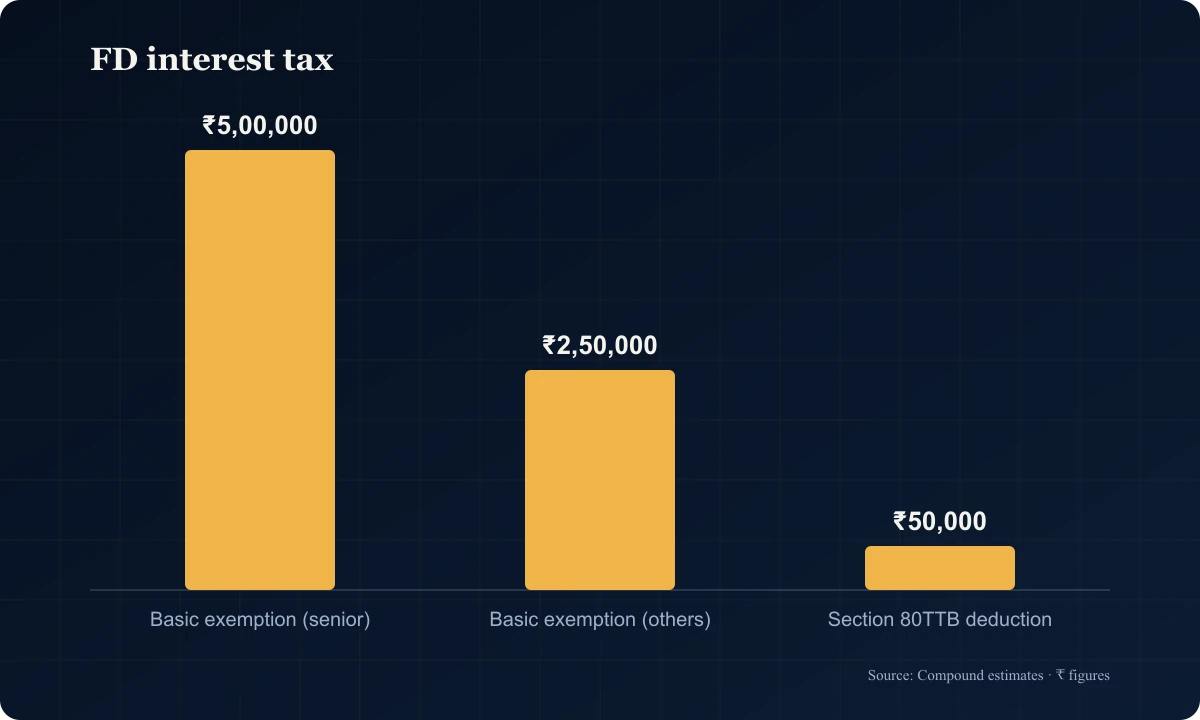
- Higher basic exemption limit: ₹5 lakh (versus ₹2.5 lakh for non-seniors under the old regime)
- Section 80TTB deduction: Up to ₹50,000 deduction on interest income from deposits and savings accounts
- Concessional TDS rate: 10% (or lower based on your slab) instead of standard rates
These apply only if you file your ITR and claim them. Simply being 60+ does not automatically reduce your tax — you must declare your income correctly.
FD interest income: how it's taxed under the Income Tax Act
FD interest is classified as income from other sources under Section 56 of the Income Tax Act. It is fully taxable as ordinary income and is added to your total income to determine your tax bracket.
The key point: there is no tax-free allowance on FD interest itself. The exemption is based on your total income, not the interest amount.
How FD interest reaches your tax return
When you hold an FD with a bank:
- The bank calculates interest quarterly (usually) and credits it to your account or reinvests it
- If the interest exceeds ₹40,000 in a financial year, the bank deducts TDS at 10% (or your applicable rate if you file Form 15G/15H)
- The bank issues a Form 16A (TDS certificate) showing the tax deducted
- You must declare the full interest amount in your ITR, not the net amount after TDS
Example:
You have an FD of ₹10 lakh earning 7% annual interest.
Annual interest = ₹70,000
TDS deducted by bank = ₹70,000 × 10% = ₹7,000
Amount credited to you = ₹63,000
Amount you declare in ITR = ₹70,000 (full interest)
Tax-free FD interest limit for senior citizens in FY 2025-26
There is no absolute tax-free limit on FD interest for senior citizens. Instead, you get a higher income threshold before tax applies.
Basic exemption limit for seniors in FY 2025-26
| Category | Basic Exemption (Old Regime) | Basic Exemption (New Regime) |
|---|---|---|
| Senior citizen (60+) | ₹5 lakh | ₹3.5 lakh |
| Non-senior (below 60) | ₹2.5 lakh | ₹3.5 lakh |
Under the old regime, if your total income (including FD interest) is ₹5 lakh or less, you owe no income tax.
If your total income exceeds ₹5 lakh, only the amount above ₹5 lakh is taxed at your applicable slab rate (5%, 20%, or 30%).
Example for a senior citizen with FD interest
Scenario 1: FD interest within exemption limit
- Age: 65 years
- Monthly pension: ₹35,000 (annual: ₹4,20,000)
- FD interest earned: ₹60,000
- Total income: ₹4,80,000
- Tax liability: ₹0 (below ₹5 lakh threshold)
Even though you earned ₹60,000 in interest, no tax is due because your total income is under ₹5 lakh.
Scenario 2: FD interest exceeds exemption limit
- Age: 65 years
- Monthly pension: ₹40,000 (annual: ₹4,80,000)
- FD interest earned: ₹80,000
- Total income: ₹5,60,000
- Taxable income: ₹5,60,000 − ₹5 lakh = ₹60,000
- Tax at 5% slab: ₹60,000 × 5% = ₹3,000
In this case, ₹20,000 of your interest remains tax-free (the portion that keeps you at ₹5 lakh), and the remaining ₹60,000 is taxed.
Use the FD calculator to estimate tax
Before opening a large FD, use an FD maturity calculator to estimate your total interest income and then cross-check against the ₹5 lakh threshold to see if you'll owe tax.
How FD interest is added to your total income and which slab applies
Your total taxable income is the sum of:
- Salary or pension
- Interest from savings accounts, FDs, RDs, bonds
- Rental income (if any)
- Capital gains
- Any other income source
Once you add all sources, you compare against the exemption limit. If total income exceeds the limit, the excess is taxed at the slab rate applicable to that portion of income.
Tax slabs for senior citizens in FY 2025-26 (old regime)
| Income Slab | Tax Rate |
|---|---|
| Up to ₹5 lakh | Nil |
| ₹5 lakh to ₹10 lakh | 5% |
| ₹10 lakh to ₹50 lakh | 20% |
| Above ₹50 lakh | 30% |
Important: Tax is not charged on your entire income at the top slab. It is progressive — each slab is taxed at its own rate.
Example with progressive taxation:
- Total income: ₹8 lakh
- Exemption: ₹5 lakh
- Taxable income: ₹3 lakh
- Tax = ₹3 lakh × 5% = ₹15,000
Only the ₹3 lakh above ₹5 lakh is taxed at 5%. The first ₹5 lakh is completely exempt.
Old regime vs new regime: which is better for senior citizen FD interest
Most senior citizens benefit from the old regime because of Section 80TTB, which allows a deduction of up to ₹50,000 on interest income from deposits and savings accounts.
Comparison for a senior citizen with ₹10 lakh FD earning 7% interest
Assumptions:
- Age: 62 years
- Annual pension: ₹4,50,000
- FD interest: ₹70,000
- Total income: ₹5,20,000
Old Regime
- Total income: ₹5,20,000
- Less: Section 80TTB deduction: ₹50,000 (capped at ₹50,000 even though interest is ₹70,000)
- Taxable income: ₹4,70,000
- Tax: ₹0 (below ₹5 lakh exemption)
- Net tax: ₹0
New Regime
- Total income: ₹5,20,000
- Exemption limit: ₹3.5 lakh
- Taxable income: ₹1,70,000
- Tax at 5% slab: ₹1,70,000 × 5% = ₹8,500
- Net tax: ₹8,500
Result: Old regime saves ₹8,500 in this scenario.
Compare both regimes with your numbers
Compare old and new tax regimes using your actual pension, interest, and deductions to see which regime suits you best.
However, the new regime may be better if:
- Your total income is significantly higher (above ₹15 lakh) and you have few deductions
- You have no interest income or minimal interest income
- You expect your income to drop further in future years
Always calculate both regimes before filing your ITR.
Strategies to minimise FD interest tax legally
1. Split FDs across multiple banks to avoid TDS
TDS is deducted when FD interest from a single bank exceeds ₹40,000 in a financial year. If you split your deposits across banks, you can keep each below the threshold.
Example:
- Total FD amount: ₹10 lakh at 7% = ₹70,000 annual interest
- Split across 2 banks: ₹5 lakh each = ₹35,000 interest per bank
- TDS deducted: ₹0 (each bank's interest is below ₹40,000)
- You still declare the full ₹70,000 in your ITR, but you avoid TDS deduction and improve cash flow
Caveat: This works only if your total income remains below the exemption limit. If you owe tax, you'll pay it when filing your ITR anyway. The benefit is deferring the TDS outflow.
2. Claim Section 80TTB deduction in full
If you're in the old regime, ensure you claim the Section 80TTB deduction of up to ₹50,000 on interest income. This is a direct reduction in taxable income, not a tax credit.
In your ITR, fill Schedule 80-ITA (for old regime) and claim this deduction. Many senior citizens miss this because they file their ITR incorrectly or use incorrect forms.
3. Use tax-saving instruments alongside FDs
Combine FDs with Section 80C investments (like NSC, PPF, or ELSS) to reduce your overall taxable income. For example:
- Invest ₹1.5 lakh in NSC (8-year bonds earning around 7.5%)
- Deduction under Section 80C: ₹1.5 lakh
- This reduces your taxable income and may push your total below the exemption limit
4. Stagger FD maturities to spread income across years
If you have a large lump sum, instead of opening one large FD, open multiple FDs with staggered maturity dates. This spreads interest income across multiple financial years and may help you stay below the exemption limit in some years.
5. Claim TDS credit when filing ITR
Even if TDS is deducted, you can claim it as a credit against your tax liability when filing your ITR. If TDS exceeds your tax liability, you get a refund.
Example:
- TDS deducted by bank: ₹7,000
- Actual tax liability: ₹3,000
- Refund due: ₹4,000
Always attach Form 16A (TDS certificate) to your ITR to claim this credit.
Common mistakes senior citizens make with FD taxation
Mistake 1: Not declaring FD interest because TDS was deducted
Wrong assumption: "The bank deducted TDS, so I don't need to file an ITR."
Reality: TDS is a provisional tax. You must file your ITR and declare the full interest amount. If your total income is below the exemption limit, you'll get a refund of the TDS deducted.
Mistake 2: Forgetting to file ITR even when income is below exemption limit
Many senior citizens assume that if their total income is below ₹5 lakh, they don't need to file an ITR. This is incorrect if TDS has been deducted on their FD interest. Filing an ITR is necessary to claim a refund.
Mistake 3: Using the new regime without comparing
The new regime has a flat standard deduction of ₹50,000 (for all individuals), but no Section 80TTB deduction. For senior citizens with interest income, the old regime is almost always better. Yet many file in the new regime by default.
Mistake 4: Not keeping FD certificates and TDS certificates
Always retain:
- FD certificates (showing opening date, principal, rate, interest earned)
- Form 16A (TDS certificate from the bank)
- Bank statements showing interest credits
These are required to prove your interest income if the income tax department asks for verification.
Mistake 5: Mixing up interest from different FDs
If you hold FDs at multiple banks, track the interest from each separately. You must declare the total interest in your ITR, but TDS is calculated per bank. Confusion here can lead to incorrect ITR filing.
How to file FD interest in your ITR as a senior citizen
Step 1: Gather documents
- All FD certificates
- Form 16A from each bank (TDS certificates)
- Bank statements showing interest credits
- Proof of age (to claim senior citizen status)
Step 2: Calculate total FD interest
Add up interest earned from all FDs during FY 2025-26 (1 April 2025 to 31 March 2026).
Step 3: Choose the correct ITR form
For most senior citizens with only salary/pension and interest income, ITR-1 (Sahaj) is sufficient. If you have rental income or capital gains, use ITR-2.
Step 4: Fill Schedule 80-ITA (old regime) or Schedule 80-ITA (new regime)
For old regime:
- Schedule 80-ITA: Claim Section 80TTB deduction (up to ₹50,000)
- Schedule CYLA (if applicable): Claim loss carried forward from previous years
For new regime:
- Schedule 80-ITA (new regime): No Section 80TTB; only standard deduction of ₹50,000 applies
Step 5: Declare FD interest in Schedule 1 (Income from other sources)
In Schedule 1, under "Interest on deposits", enter the total interest from all FDs. Specify:
- Interest amount
- TDS deducted (if any)
- Bank names and Form 16A reference numbers
Step 6: Claim TDS credit
In Schedule 6 (TDS and other taxes paid), enter the total TDS deducted on FD interest. This will be credited against your tax liability.
Step 7: File and track
File your ITR before 31 July 2026 (for FY 2025-26). Keep the acknowledgment and track your refund status on the income tax e-filing portal.
Frequently asked questions
Q: Is FD interest taxable for senior citizens in India?
Yes, FD interest is taxable as income. However, senior citizens (age 60+) have a higher income threshold (₹5 lakh in FY 2025-26) before tax applies, and may benefit from concessional treatment under Section 80TTB if they have no other source of income.
Q: How much FD interest is tax-free for senior citizens?
There is no blanket tax-free limit on FD interest itself. Instead, senior citizens get a higher basic exemption limit of ₹5 lakh (versus ₹2.5 lakh for others under the old regime). Interest beyond this is taxed at your applicable slab rate.
Q: Should a senior citizen choose old or new tax regime for FD interest?
Most senior citizens benefit from the old regime because of Section 80TTB (up to ₹50,000 deduction on interest income) and higher exemption limits. Use an income tax estimator to compare both regimes with your actual income.
Q: Do senior citizens pay TDS on FD interest?
Yes. Banks deduct TDS at 10% (or your applicable rate) on FD interest exceeding ₹40,000 in a financial year. You can claim this TDS as a credit when filing your ITR.
Q: Can a senior citizen avoid tax on FD interest?
Not legally. However, you can minimise tax by splitting FDs across banks (to stay under ₹40,000 per bank to avoid TDS), choosing the old regime, and claiming all eligible deductions like Section 80TTB.
Disclaimer
This article is educational content about FD interest taxation for senior citizens in India under FY 2025-26 rules. It is not investment advice or tax advice. Tax treatment depends on your individual circumstances, income, age, and residency status. Always consult a qualified tax professional or Chartered Accountant before making decisions about your FDs or filing your ITR. The figures and rates mentioned are current as of June 2026 and may change in future financial years.