Section 80TTB tax exemption for senior citizens FY 2025-26
Section 80TTB exempts ₹50,000 of FD/savings interest for senior citizens in FY 2025-26. Learn eligibility, calculation, and how to claim this tax relief.
If you're a senior citizen with fixed deposits, savings accounts, or other interest-bearing investments, Section 80TTB offers you a tax shield worth understanding. This section lets you claim an exemption of up to ₹50,000 on interest income in FY 2025-26—but only if you know how to apply it correctly. Here's what you need to know to maximize this benefit and avoid costly mistakes.
What is Section 80TTB and who qualifies
Section 80TTB is a tax deduction introduced in the Union Budget 2023 specifically for senior citizens. It allows you to deduct up to ₹50,000 of interest income from your taxable income, provided you meet the eligibility criteria.
The intent is clear: the government recognizes that many retirees live on interest from fixed deposits and savings accounts, and this deduction reduces the tax burden on that income. Unlike some other deductions that require you to spend money (like Section 80C for insurance premiums), Section 80TTB is a direct reduction on income you've already earned.
The exemption applies to interest from:
- Fixed deposits (FDs) in banks and post offices
- Savings accounts
- Senior citizen savings schemes
- Other specified interest-bearing sources
What it does not include:
- Capital gains from investments
- Dividend income
- Rental income
- Interest on personal loans you've given
The ₹50,000 exemption limit explained
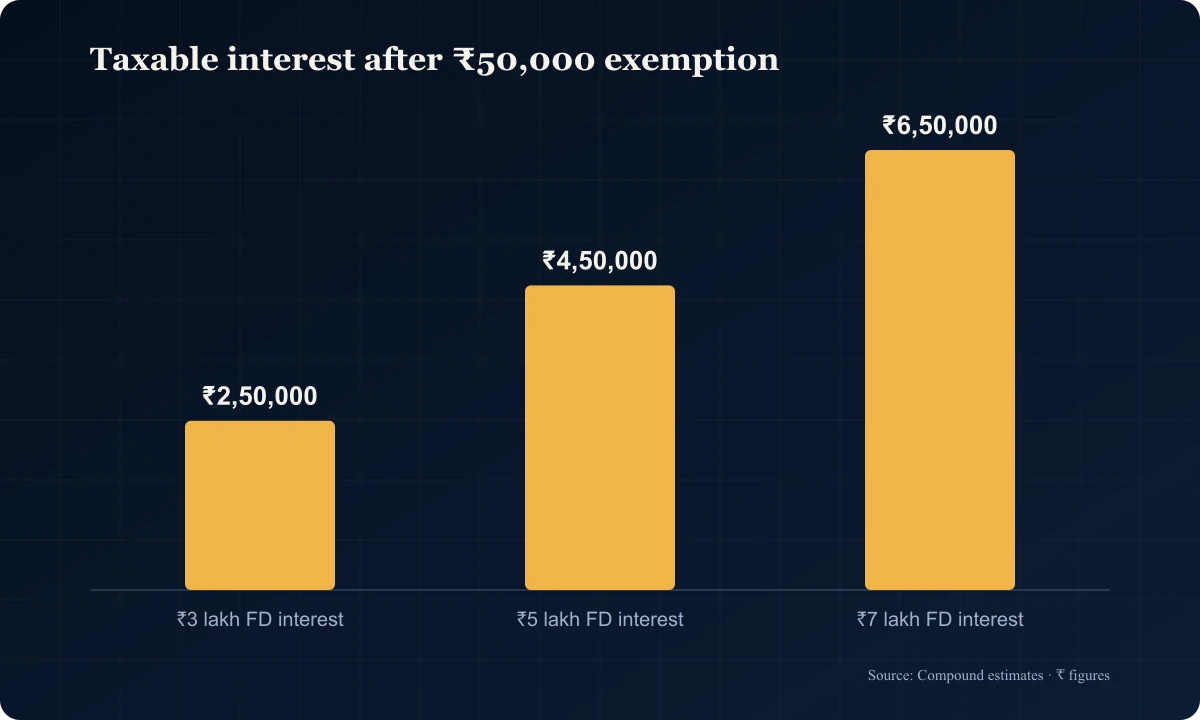
The core benefit is straightforward: you can exclude up to ₹50,000 of your interest income from tax. Here's how it works in practice.
If your total interest income in FY 2025-26 is ₹40,000 (say, from two FDs), your taxable interest becomes ₹0. The entire amount falls within the exemption.
If your interest income is ₹75,000, you deduct ₹50,000, leaving ₹25,000 as taxable income. That ₹25,000 is then added to your other income and taxed at your applicable slab rate.
The exemption is a combined limit across all sources. If you have five FDs earning interest, you don't get ₹50,000 per FD—you get one ₹50,000 exemption pool that covers all your interest income combined.
The exemption is all-or-nothing
You cannot claim a partial exemption. If your interest income is ₹30,000, you claim ₹30,000 exemption (not ₹50,000). If it's ₹75,000, you claim ₹50,000, and ₹25,000 is taxable.
Eligibility criteria: age, income, and residency
To claim Section 80TTB in FY 2025-26, you must meet all of these conditions:
Age: You must be 60 years or older at any point during the financial year (1 April 2025 to 31 March 2026). If you turn 60 on 1 March 2026, you qualify for the entire FY 2025-26.
Residency: You must be a resident of India for the financial year. Non-resident Indians (NRIs) cannot claim this deduction.
Income source: The ₹50,000 exemption applies only to interest income as defined above. It does not reduce other forms of income or total income thresholds.
Filing requirement: You must file an income tax return (ITR) to claim Section 80TTB. Even if your total income falls below the ITR filing threshold, you must file to claim this deduction. The exemption is not automatic—it must be claimed on your return.
There is no upper income limit. A senior citizen earning ₹50 lakhs can claim Section 80TTB just as a senior citizen earning ₹5 lakhs can, as long as they file an ITR.
How to calculate taxable interest after the exemption
The calculation is simple but must be done carefully, especially if you have multiple income sources.
Step 1: Add up all interest income from eligible sources (FDs, savings accounts, senior citizen schemes, etc.).
Step 2: Subtract ₹50,000 (or your actual interest income if it's less than ₹50,000).
Step 3: The result is your taxable interest income.
Step 4: Add this to your other income (salary, pension, rental income, etc.) to arrive at total income.
Step 5: Calculate tax at your applicable slab rate under the old tax regime.
Here's a worked example:
| Item | Amount |
|---|---|
| Pension income | ₹4,00,000 |
| Interest from FD 1 | ₹30,000 |
| Interest from FD 2 | ₹25,000 |
| Interest from savings account | ₹10,000 |
| Total interest income | ₹65,000 |
| Less: Section 80TTB exemption | ₹50,000 |
| Taxable interest | ₹15,000 |
| Total taxable income | ₹4,15,000 |
Under the old tax regime for FY 2025-26, assuming standard deductions and no other deductions, tax would be calculated on ₹4,15,000. The ₹50,000 exemption saved you tax on ₹50,000 of interest—a saving of roughly ₹7,500 to ₹10,000 depending on your slab.
Common mistakes: what interest counts and what doesn't
Many senior citizens misunderstand the scope of Section 80TTB. Here are the most common errors:
Mistake 1: Treating capital gains as interest. If you sell an FD before maturity and earn a gain, that's not interest—it's capital gain. Section 80TTB doesn't apply. Only the interest component of your FD earnings qualifies.
Mistake 2: Assuming dividend income qualifies. Dividends from stocks or mutual funds are not interest. Section 80TTB does not cover them.
Mistake 3: Claiming the exemption without filing an ITR. You cannot claim Section 80TTB through a tax deducted at source (TDS) adjustment or a belated return. You must file an ITR within the due date (usually 31 July after the financial year ends).
Mistake 4: Double-counting interest already exempt under Section 10(15H). The Senior Citizen Savings Scheme (SCSS) offers interest that may already be partially exempt under other provisions. Ensure you don't claim overlapping exemptions. Read the scheme rules carefully.
Mistake 5: Claiming ₹50,000 per FD instead of a combined limit. If you have three FDs earning ₹20,000 each, your total exemption is still ₹50,000 across all three, not ₹50,000 per FD.
TDS and the exemption
If your bank deducts TDS on interest, you still claim the Section 80TTB exemption on your ITR. The TDS is adjusted against your final tax liability. The exemption reduces your taxable income; TDS is a credit against tax paid.
Step-by-step: claiming 80TTB on your ITR
Filing your ITR to claim Section 80TTB is straightforward if you follow the process.
Step 1: Choose the right ITR form. Most senior citizens file ITR-1 (Sahaj) if they have income from salary, pension, and interest only. If you have business or rental income, use ITR-2 or ITR-3.
Step 2: Report all interest income. In the ITR, you'll find a section for "Income from other sources." Report your total interest income from all eligible sources here. Do not hide or underreport; the bank will file TDS returns showing the interest paid to you.
Step 3: Claim the Section 80TTB deduction. In the deductions section of the ITR (Schedule 80), you'll see a line for Section 80TTB. Enter the amount you're claiming—up to ₹50,000, but not more than your actual interest income.
Step 4: Verify your total income and tax. The ITR software will automatically calculate your taxable income after the deduction and compute your tax liability.
Step 5: File before the due date. For FY 2025-26, the due date to file your ITR is 31 July 2026 (or 31 December 2026 if you have foreign assets or are a specified person). Filing early avoids penalties.
Step 6: Keep records. Maintain copies of FD certificates, bank statements, and TDS certificates (Form 16A) for at least 5 years.
You can file your ITR online via the Income Tax Department's portal (www.incometax.gov.in) or through a CA if you prefer professional help.
Real examples: ₹5 lakh, ₹10 lakh, and ₹20 lakh FD scenarios
Let's walk through three realistic scenarios to show how Section 80TTB applies.
Scenario 1: Senior citizen with ₹5 lakh FD
- FD amount: ₹5,00,000
- FD tenure: 1 year
- FD rate: 6.5% per annum
- Interest earned: ₹32,500
- Pension income: ₹3,50,000
- Other income: Nil
Taxable interest after Section 80TTB: ₹32,500 − ₹50,000 = ₹0 (exemption exceeds interest).
Total taxable income: ₹3,50,000 (pension only).
Tax under old regime (FY 2025-26, assuming standard deduction): Roughly ₹0 to ₹5,000 depending on exact pension structure.
Benefit: The entire ₹32,500 interest is tax-free.
Scenario 2: Senior citizen with ₹10 lakh in FDs
- FD 1: ₹6,00,000 @ 6.5% = ₹39,000 interest
- FD 2: ₹4,00,000 @ 6% = ₹24,000 interest
- Total interest: ₹63,000
- Pension income: ₹5,00,000
- Other income: Nil
Taxable interest after Section 80TTB: ₹63,000 − ₹50,000 = ₹13,000.
Total taxable income: ₹5,13,000.
Tax under old regime (FY 2025-26): Roughly ₹28,000 to ₹35,000 (depending on deductions).
Benefit: The ₹50,000 exemption saved you tax of approximately ₹7,500 to ₹10,000.
Scenario 3: Senior citizen with ₹20 lakh in FDs
- FD 1: ₹12,00,000 @ 6.5% = ₹78,000 interest
- FD 2: ₹8,00,000 @ 6% = ₹48,000 interest
- Total interest: ₹1,26,000
- Pension income: ₹8,00,000
- Other income: Nil
Taxable interest after Section 80TTB: ₹1,26,000 − ₹50,000 = ₹76,000.
Total taxable income: ₹8,76,000.
Tax under old regime (FY 2025-26): Roughly ₹1,25,000 to ₹1,40,000.
Benefit: The ₹50,000 exemption saved you tax of approximately ₹7,500 to ₹10,000.
Note: The tax saving is the same in all three scenarios (₹7,500–₹10,000) because the exemption is capped at ₹50,000. In Scenario 3, you still benefit, but the high interest income means a larger portion remains taxable.
Use our FD calculator to estimate your interest earnings and adjust your investment strategy accordingly.
Interaction with other deductions and tax regimes
Section 80TTB works within a specific framework. Understanding its interaction with other rules is crucial.
Old tax regime only: Section 80TTB is available only under the old tax regime. If you opt for the new tax regime (introduced in 2020), you cannot claim this deduction. Senior citizens must choose the old regime to benefit from Section 80TTB.
For most senior citizens, the old regime is more beneficial because of deductions like Section 80C (life insurance, EPF), Section 80D (health insurance), and Section 80TTB itself. Use our income tax estimator to compare old vs. new regime for your specific situation.
Interaction with Section 80C and other deductions: Section 80TTB is independent of other deductions. If you also claim Section 80C (say, ₹1,50,000 for life insurance), you can claim Section 80TTB on top of it. The deductions are cumulative.
Interaction with standard deduction: If you have salary or pension income, you may be eligible for a standard deduction (₹50,000 for salaried individuals, ₹15,000 for pensioners under the old regime). This deduction is separate from Section 80TTB and can be claimed alongside it.
Interaction with TDS: If your bank deducts TDS on interest (typically at 10% if you don't furnish Form 15G/15H), you still claim the full Section 80TTB exemption on your ITR. The TDS is credited against your final tax liability.
Interaction with surcharge and cess: The Section 80TTB exemption reduces your taxable income, which may also lower your surcharge liability if your income crosses certain thresholds (₹50 lakhs, ₹1 crore, etc.). Health and education cess is calculated on the tax after exemptions.
For a comprehensive understanding of how interest taxation works for seniors, refer to our comprehensive guide to FD interest taxation for senior citizens in India FY 2025-26.
Explore more tax deductions and planning strategies to optimize your overall tax position.
Frequently asked questions
Q: What is the Section 80TTB exemption limit for senior citizens in FY 2025-26?
Senior citizens can claim an exemption of up to ₹50,000 on interest income from savings accounts, FDs, and other specified sources under Section 80TTB.
Q: Do I need to file an ITR to claim Section 80TTB?
Yes, you must file an ITR (even if your total income is below the threshold) to claim the Section 80TTB deduction. The exemption is not automatic.
Q: Is Section 80TTB available if I earn interest from multiple FDs?
Yes. The ₹50,000 exemption applies to your total interest income from all eligible sources combined, not per FD.
Q: Can I claim Section 80TTB under the new tax regime?
No. Section 80TTB is only available under the old tax regime. Senior citizens must file under the old regime to benefit from this deduction.
Q: What age qualifies me as a senior citizen for Section 80TTB?
You must be 60 years or older at any point during the financial year to claim Section 80TTB.
Disclaimer
This article is educational content intended to help you understand Section 80TTB and tax rules for senior citizens in India. It is not investment advice, tax advice, or a substitute for professional consultation. Tax laws change, and individual circumstances vary. Consult a qualified chartered accountant or tax professional before making decisions about your FDs, tax filing, or financial planning. The figures and examples provided are illustrative and based on FY 2025-26 rules current as of June 2026. Always verify current rates, limits, and rules with official sources or your tax advisor.