Sukanya Samriddhi tax benefits and interest rate 2026
Sukanya Samriddhi tax benefits explained for FY 2026-27: current 8.2% interest rate, ₹1.5L Section 80C deduction, and tax-free maturity. See if SSY beats you…
Sukanya Samriddhi tax benefits stack up across three separate sections of the Income Tax Act, which is why this small savings scheme remains the most tax-efficient way to save for a daughter's education and marriage in India. Below we break down the current 8.2% interest rate for FY 2026-27, the exact Section 80C deduction limit, how maturity is treated under Section 10(11A), and how SSY compares head-to-head with PPF and SIPs.
What is Sukanya Samriddhi Yojana and who can open it
Sukanya Samriddhi Yojana (SSY) is a government-backed small savings scheme launched in January 2015 under the Beti Bachao Beti Padhao initiative. It is designed specifically to encourage parents to build a corpus for their daughter's higher education and marriage.
Who can open an account
- A parent or legal guardian can open the account in the name of a girl child.
- The girl child must be under 10 years of age at the time of account opening. There was a one-time relaxation for girls born between 2 December 2003 and 1 December 2015, but for new accounts in 2026 the under-10 rule applies.
- Only one account per girl child is allowed.
- A family can open a maximum of two accounts — one for each daughter. An exception exists for twins or triplets, allowing a third account.
- Accounts can be opened at India Post offices or authorised branches of most public sector banks and a few private banks such as ICICI Bank and HDFC Bank.
Key deposit rules
- Minimum annual deposit: ₹250
- Maximum annual deposit: ₹1.5 lakh
- Deposit tenure: 15 years from the year of account opening
- Maturity: 21 years from the year of opening
- The account can be opened any time after the girl's birth, as long as she is under 10.
Sukanya Samriddhi interest rate for FY 2026-27
The Sukanya Samriddhi interest rate for FY 2026-27 is 8.2% per annum, compounded annually. The government notifies small savings rates quarterly, but the SSY rate has held at 8.2% since the October–December 2024 quarter and continues into FY 2026-27.
How the interest is calculated
- Interest is calculated on the lowest balance between the 5th and the end of each month, so deposits made before the 5th earn interest for that full month.
- Interest is credited at the end of the financial year, on 31 March.
- Compounding is annual, not monthly.
At 8.2%, SSY is currently the highest-yielding small savings scheme that also carries a sovereign guarantee. PPF pays 7.1%, the Senior Citizen Savings Scheme pays 8.2% but has a five-year lock-in and a minimum-age restriction, and NSC pays 7.7%. If you are comparing SSY with bank fixed deposits, remember that FD interest is fully taxable at your slab rate — see our explainer on how FD interest is taxed for senior citizens and the Section 80TTB tax exemption limits for context on how interest income is treated differently across instruments.
Three Sukanya Samriddhi tax benefits explained
SSY enjoys EEE (Exempt-Exempt-Exempt) status, which is the gold standard for tax efficiency in India. Here is exactly how the three legs of the Sukanya Samriddhi tax benefits work.
1. Exempt on contribution — Section 80C
Deposits made into the SSY account qualify for deduction under Section 80C of the Income Tax Act, up to ₹1.5 lakh per financial year. This reduces your taxable income directly.
2. Exempt on interest accrual
The interest credited each year to the SSY account is entirely tax-free. There is no TDS deduction, no annual tax on the accrued interest, and the interest does not need to be declared as "income from other sources" in your return.
3. Exempt on maturity — Section 10(11A)
When the account matures after 21 years, or is closed early for marriage or education under the permitted rules, the entire amount — principal plus accumulated interest — is tax-free under Section 10(11A) of the Income Tax Act.
This three-layer exemption is what makes SSY more powerful than it looks at first glance. A taxable 8.2% return in the 30% slab is effectively only 5.74% post-tax. The SSY's 8.2% stays 8.2%.
Section 80C deduction limit for SSY in FY 2026-27
For FY 2026-27, the Section 80C deduction limit remains ₹1.5 lakh per financial year. SSY deposits fall within this overall limit, which is shared with other 80C instruments:
- Employees' Provident Fund (EPF)
- Public Provident Fund (PPF)
- Equity Linked Savings Scheme (ELSS)
- Life insurance premiums
- Principal repayment on home loan
- National Savings Certificate (NSC)
- Tuition fees for children
Important: 80C applies only under the old tax regime
The new tax regime is the default regime, but it does not allow Section 80C deductions. If you are filing under the new regime, your SSY deposits will not reduce your taxable income — though the interest and maturity remain tax-free regardless of which regime you choose.
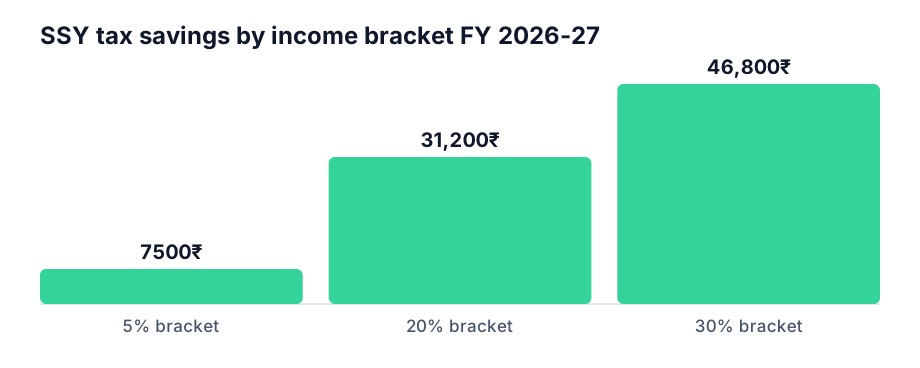
How much tax you actually save
| Tax slab (old regime) | Tax saved on ₹1.5 lakh deposit |
|---|---|
| 5% | ₹7,800 |
| 20% | ₹31,200 |
| 30% | ₹46,800 |
The ₹46,800 figure at the 30% slab includes the 4% health and education cess (30% plus 4% cess equals 31.2% effective rate on ₹1.5 lakh). If you also pay surcharge, the saving is higher.
Is Sukanya Samriddhi maturity fully tax-free
Yes — and this is the part most articles gloss over. The maturity amount is fully tax-free under Section 10(11A), which was specifically inserted into the Income Tax Act for Sukanya Samriddhi accounts.
What is tax-free at maturity
- The entire principal you deposited over 15 years
- The entire accumulated interest compounded at 8.2% or the prevailing rate each year
- Any partial withdrawal made for higher education after the girl turns 18
What is not taxed even on premature closure
If the account is closed early for the girl's marriage after she turns 18, or on compassionate grounds such as death of the depositor or serious illness, the proceeds remain tax-free. There is no TDS on any withdrawal or closure.
This is a meaningful distinction. Compare this with an equity mutual fund where LTCG above ₹1.25 lakh is taxed at 12.5%, or a bank FD where the entire interest is taxed at your slab rate. The SSY's tax-free status at maturity is what pushes its effective yield well above most other fixed-income options.
SSY vs PPF vs SIP: which saves more tax
Here is a head-to-head comparison of the three most common long-term savings options Indian parents use for their children.
| Feature | SSY | PPF | SIP (equity mutual funds) |
|---|---|---|---|
| Current interest / expected return | 8.2% guaranteed | 7.1% guaranteed | 10–12% expected, market-linked |
| 80C deduction | Yes, up to ₹1.5L | Yes, up to ₹1.5L | Only ELSS, up to ₹1.5L |
| Interest / returns tax | Fully tax-free | Fully tax-free | LTCG 12.5% above ₹1.25L |
| Maturity tax | Fully tax-free | Fully tax-free | Taxed on gains |
| Lock-in | 21 years, deposit for 15 | 15 years | 3 years for ELSS, none for regular SIP |
| Who can open | Parents of girl child under 10 | Any Indian citizen | Any resident |
| Risk | Sovereign guaranteed | Sovereign guaranteed | Market risk |
When SSY wins
SSY wins when you have a daughter under 10, want a guaranteed return, and value the EEE tax treatment. The 8.2% tax-free return is hard to beat in fixed income.
When PPF wins
PPF wins if you do not have a daughter, or if the girl is over 10 and ineligible for SSY. PPF also has a shorter 15-year lock-in and allows partial withdrawals from the 7th year onwards.
When SIP wins
SIPs win when you need flexibility, higher long-term returns, and the ability to step up or pause contributions. Over 21 years, equity SIPs have historically delivered 11–13% CAGR, but those gains are taxed at 12.5% on LTCG above ₹1.25 lakh per year. For a deeper comparison of monthly savings vehicles, see our SIP vs RD comparison for monthly savings.
A practical approach: use SSY for the guaranteed, tax-free foundation, and run a separate equity SIP for growth. If you are targeting a specific corpus, our breakdown of the monthly savings needed to reach ₹1 crore shows how different instruments compound over a decade.
How compounding works over 21 years in SSY
SSY's real power is the 21-year compounding window. You deposit for 15 years, but the money continues to earn interest for 6 more years until maturity — without any fresh deposits.
Example: ₹1.5 lakh per year for 15 years
Assume you deposit ₹1.5 lakh at the start of each financial year for 15 years, and the rate stays at 8.2% throughout.
- Total amount deposited: ₹22.5 lakh
- Maturity value at end of 21 years: approximately ₹71 lakh
- Total interest earned: approximately ₹48.5 lakh
The last 6 years are where compounding does the heavy lifting. At the end of year 15, the corpus is roughly ₹44.8 lakh. That ₹44.8 lakh then grows to roughly ₹71 lakh over the next 6 years without a single additional rupee being deposited — that is about ₹26 lakh of growth from pure compounding.
Example: ₹1 lakh per year for 15 years
- Total deposited: ₹15 lakh
- Maturity at 21 years: approximately ₹47 lakh
- Interest earned: approximately ₹32 lakh
Example: ₹50,000 per year for 15 years
- Total deposited: ₹7.5 lakh
- Maturity at 21 years: approximately ₹24 lakh
- Interest earned: approximately ₹16.5 lakh
The gap between ₹50,000 and ₹1.5 lakh per year is only ₹15 lakh of additional deposits, but it produces roughly ₹47 lakh of additional maturity value. That is the asymmetric payoff of maxing out the 80C limit early.
A note on rate changes
The 8.2% rate is not locked for the full 21 years — the government revises it quarterly. If the rate drops to 7.5% for the entire period, the ₹1.5 lakh-per-year example matures at roughly ₹66 lakh instead of ₹71 lakh. If it rises to 8.5%, the maturity moves to roughly ₹74 lakh. The sovereign backing means the capital itself is never at risk; only the rate varies.
Withdrawal and maturity rules to know
Normal maturity
The account matures 21 years from the year of opening. If you opened the account in 2026, it matures in 2047. At maturity, the entire balance can be withdrawn by the account holder — the daughter — with a closure form and KYC documents.
Partial withdrawal for higher education
- Allowed after the girl child turns 18.
- Maximum withdrawal: 50% of the balance at the end of the preceding financial year.
- The withdrawal is for higher education purposes only, and proof of admission may be required.
- The withdrawal is tax-free.
Premature closure for marriage
- The account can be closed early for the girl's marriage, but only after she turns 18.
- The marriage must be scheduled, and closure is allowed up to 60 days before the wedding date.
- Proceeds are tax-free.
Premature closure on compassionate grounds
The government permits premature closure before 21 years in specific cases:
- On the death of the account holder, the girl child
- On the death of the depositor, the parent or guardian, with the option to continue the account until maturity
- On compassionate grounds such as life-threatening illness of the account holder, supported by medical documentation
Keeping the account active
- Deposit at least ₹250 per year to keep the account active.
- If the minimum is not met, the account is marked as defaulted and a ₹50 per year penalty applies.
- A defaulted account can be regularised by paying the penalty plus the minimum deposit for each missed year.
- If the account is not regularised, it continues to earn interest but no further deposits are accepted.
What happens after maturity if you do not withdraw
If the account is not closed at maturity, it continues to earn interest at the prevailing SSY rate until the account holder withdraws it. This is useful if the daughter wants to keep the money invested in a sovereign-guaranteed instrument while she decides on its use.
Frequently asked questions
What is the Sukanya Samriddhi interest rate for 2026?
The Sukanya Samriddhi Yojana interest rate for FY 2026-27 is 8.2% per annum, compounded annually. The government revises this rate every quarter.
Is Sukanya Samriddhi maturity amount taxable?
No, the maturity amount including principal and interest is completely tax-free under Section 10(11A) of the Income Tax Act.
How much tax can I save with Sukanya Samriddhi?
You can claim a deduction of up to ₹1.5 lakh per year under Section 80C, saving up to ₹46,800 in taxes annually if you fall in the 30% tax bracket.
Can I open more than one Sukanya Samriddhi account?
No, only one account per girl child is allowed, and a parent or legal guardian can open maximum two accounts for two different daughters.
What happens if I deposit more than ₹1.5 lakh in SSY?
You can deposit up to ₹1.5 lakh per year. Any excess deposit will not qualify for the Section 80C deduction, though it will still earn the 8.2% interest.