How much term insurance cover do I need in India?
Calculate how much term insurance cover you need in India using two simple methods. Find the right cover amount to secure your family's financial future.

If you are wondering how much term insurance cover do I need in India, the answer is not a round number picked at random — it is a figure rooted in your income, your loans, how many people depend on you, and the years of earning ahead of you. This guide walks you through the Human Life Value and income replacement methods with real numbers, so you can calculate your exact cover instead of guessing.
Why your term insurance cover amount matters
Term insurance is the only insurance product that pays a lump sum to your family if you die during the policy term — and nothing if you survive it. That purity of purpose is exactly why the cover amount matters so much. Under-insure, and your family gets a cheque that runs out in five years. Over-insure, and you bleed premium money that could have gone into mutual funds or your child's education.
The core question is not "how much premium can I afford?" — it is "how much money does my family need to maintain their lifestyle and meet future goals if my income stops tomorrow?"
A ₹1 crore cover sounds large in conversation. But if you earn ₹12 lakh a year, have a ₹40 lakh home loan, and a four-year-old child, that ₹1 crore shrinks fast once you account for loan repayment, household expenses, and education costs. The right cover amount is a calculated number, not a marketing benchmark.
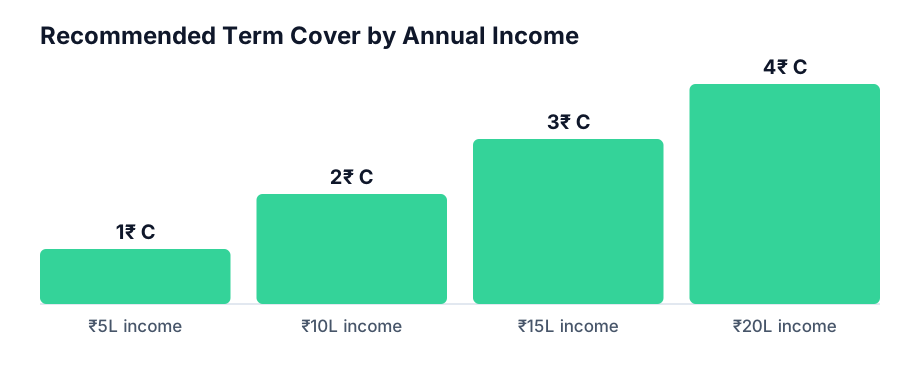
The 15-20x annual income rule explained with examples
The simplest rule used in India is: your term insurance cover should be 15 to 20 times your annual gross income. This works as a quick estimate because it approximates the number of years your family would need income replacement, adjusted for inflation and existing assets.
Here is how the rule plays out across three income levels:
| Annual income | 15x cover | 20x cover | Recommended range |
|---|---|---|---|
| ₹5 lakh | ₹75 lakh | ₹1 crore | ₹75 lakh – ₹1 crore |
| ₹12 lakh | ₹1.8 crore | ₹2.4 crore | ₹1.8 crore – ₹2.4 crore |
| ₹25 lakh | ₹3.75 crore | ₹5 crore | ₹3.75 crore – ₹5 crore |
The rule is a starting point, not the finish line. It does not account for your home loan, your child's education corpus, or your spouse's earning capacity. Use the 15-20x figure as a floor, then refine it using the methods below.
Human Life Value (HLV) method: how to calculate
The Human Life Value approach treats you as a financial asset. Your life has a monetary value equal to the present value of all the income you would have earned for your family over your remaining working years, minus what you would have spent on yourself.
HLV calculation steps
- Calculate your annual contribution to the family: Gross income minus personal expenses, taxes, and life insurance premiums. This is the money that actually supports your household.
- Estimate remaining working years: Retirement age minus current age. A 30-year-old planning to retire at 60 has 30 working years left.
- Apply a discount rate: Use 6-8% to account for inflation and the time value of money. Most Indian calculators default to around 7%.
- Subtract existing assets and life insurance: If you already have group cover from your employer or an existing policy, deduct that from the HLV.
HLV example: 30-year-old earning ₹12 lakh
- Annual income: ₹12,00,000
- Personal expenses and taxes: ₹3,00,000
- Annual family contribution: ₹9,00,000
- Remaining working years: 30
- Discount rate: 7%
Using the present value of an annuity formula: HLV = ₹9,00,000 × [(1 – (1 + 0.07)^-30) / 0.07] = approximately ₹1.12 crore.
Add outstanding loans: ₹40 lakh home loan → total need = ₹1.52 crore.
Deduct existing assets and cover: ₹10 lakh in savings and ₹10 lakh employer group cover → net cover required = ₹1.32 crore.
This is the human life value calculation term insurance approach — more precise than a multiple, but still a simplification. It assumes your income stays flat in real terms and does not factor in future goals like children's education separately.
Term insurance cover income replacement method: step-by-step with real numbers
The income replacement method focuses on what your family actually needs to replace your income for a defined period — usually until your dependants become financially independent or your spouse reaches retirement age.
Step 1: Determine your family's annual expenses
Include household expenses, EMIs, school fees, and any recurring financial commitments your family would continue to have.
Step 2: Subtract income from other sources
If your spouse earns, or if you have rental income, subtract that from the annual expense figure. You only need to replace the gap.
Step 3: Decide the replacement period
A common approach is to replace income until your youngest child becomes financially independent, or for 15-20 years — whichever is longer.
Step 4: Calculate the present value of the replacement income
Use an inflation-adjusted discount rate (typically 5-6% real rate) to find the lump sum needed today.
Real calculation for three income levels
Assumptions: family needs 70% of your gross income, spouse has no income, replacement period is 18 years, real discount rate is 5%.
| Annual income | 70% needed | PV factor (18 yrs at 5%) | Income replacement | Add loans | Less existing assets | Cover needed |
|---|---|---|---|---|---|---|
| ₹5 lakh | ₹3.5 lakh | 11.69 | ₹40.9 lakh | ₹10 lakh | ₹3 lakh | ₹47.9 lakh |
| ₹12 lakh | ₹8.4 lakh | 11.69 | ₹98.2 lakh | ₹40 lakh | ₹10 lakh | ₹1.28 crore |
| ₹25 lakh | ₹17.5 lakh | 11.69 | ₹2.05 crore | ₹60 lakh | ₹20 lakh | ₹2.45 crore |
Note: The PV factor of 11.69 is the present value annuity factor for 18 years at a 5% real rate. This means ₹1 of annual income for 18 years is worth ₹11.69 as a lump sum today.
The income replacement method gives you a more tailored number than the 15-20x rule because it accounts for your spouse's income, your existing assets, and the specific time horizon your family faces.
How age, loans and dependants change your cover needs
Your term insurance need is not static — it shifts with life stage.
Age
A term insurance for 30 year old India needs to cover a longer income replacement horizon than someone buying at 45. The 30-year-old has 30 working years ahead; the 45-year-old has 15. But the 30-year-old also locks in a far lower premium for the entire term, which is why buying early is almost always the right call.
By the time you cross 60, your needs change significantly — if you still need cover, read about term insurance for senior citizens above 60 to understand how cover calculations shift post-retirement.
Loans
Every rupee of outstanding loan should be added to your cover amount. If you have a ₹40 lakh home loan and a ₹5 lakh car loan, your cover increases by ₹45 lakh. Some people buy a separate term plan equal to their home loan and let it run alongside the loan tenure — this works, but it is simpler to have one comprehensive policy.
Dependants
One working spouse with no children needs less cover than a single-income family with two children and elderly parents. Count your dependants and map their financial needs:
- Spouse's financial independence timeline
- Children's education and marriage corpus
- Parents' medical and living expenses if they depend on you
If you are simultaneously planning long-term goals, the income you are protecting is also the income funding goals like building a ₹1 crore corpus through SIP or creating a retirement corpus for ₹50,000 monthly income. Your term cover should be large enough that these goals do not collapse if you are not around.
Term insurance tax benefits under Section 80C in FY 2026-27
Premiums paid for term insurance qualify for deduction under Section 80C of the Income Tax Act, up to a combined limit of ₹1.5 lakh per financial year. In FY 2026-27, this limit remains unchanged.
Key points to know:
- The deduction is available for premiums paid for yourself, your spouse, and your children.
- For policies issued on or after 1 April 2012, the deduction is capped at 10% of the sum assured if the life insured is below 60 years, and 15% if the life insured is 60 or above.
- The death benefit received by the nominee is tax-free under Section 10(10D), subject to the same premium-to-sum-assured ratio conditions.
Term insurance premiums are typically a few thousand rupees a year for a cover of ₹1 crore or more, so you will rarely hit the 10% cap. A 30-year-old non-smoker can get a ₹1 crore cover for approximately ₹10,000-15,000 per year, which is well under the ₹1,00,000 (10% of ₹1 crore) threshold.
If you are using Section 80C fully and looking for other tax-saving instruments, explore these Section 80C tax-saving investments for the full picture.
Common mistakes when choosing term insurance cover
Buying too little cover
The most common mistake is treating ₹1 crore as a default number. For incomes above ₹6-7 lakh, especially with a home loan and children, ₹1 crore is inadequate. Run the income replacement calculation and buy the number it gives you.
Ignoring inflation
A cover that looks adequate today will be worth far less in 15-20 years. If your cover is ₹1 crore today, at 5% inflation it has the purchasing power of roughly ₹38 lakh after 20 years. Either buy a higher cover or choose a plan with an increasing cover option.
Under-disclosing health details
Hiding conditions like diabetes, hypertension, or past surgeries to save on premium is a guaranteed way to get a claim rejected. Insurers check medical history at the claim stage, and non-disclosure gives them legal grounds to deny the payout.
Buying too many riders
Critical illness, accidental death, and waiver of premium riders sound useful but they can double your premium. Buy them only if you have a specific need and have evaluated standalone alternatives. Often, a standalone health insurance plan and an accident policy are cheaper and broader than riders.
Choosing too short a term
A 30-year-old buying a 20-year term plan is left without cover at 50, when they may still have dependants and loans. Buy a term that runs at least until your retirement age or until your youngest child becomes financially independent — whichever is later.
When should you review your term insurance cover?
Review your cover at these life events:
- Marriage: Your spouse becomes a dependant; income replacement needs recalculation.
- Birth or adoption of a child: Add education and upbringing costs.
- New home loan or major debt: Add the loan amount to your cover.
- Significant income jump: If your income rises 30% or more, your cover should rise proportionately.
- New dependant (e.g., aging parents): Add their financial needs to your cover calculation.
- Every 5 years regardless: Income, expenses, and goals shift; a periodic check ensures your cover is still adequate.
A term insurance cover calculator India tool can help you re-run the numbers quickly at each review point. But the calculator is only as good as the inputs — understand the method behind it.
Frequently asked questions
What is the ideal term insurance cover amount in India?
Most financial experts recommend a term insurance cover of 15-20 times your annual income, plus outstanding loans and future financial goals like children's education.
Should I include my home loan in my term insurance cover?
Yes, your term insurance cover should be enough to repay all outstanding loans including your home loan, so your family is not burdened with debt if something happens to you.
Can I buy multiple term insurance policies in India?
Yes, you can buy multiple term insurance plans from different insurers. Just ensure you disclose all existing policies to each insurer at the time of application.
Is ₹1 crore term insurance enough for a middle-class family?
₹1 crore may be sufficient if your annual income is below ₹5-6 lakh and you have minimal loans. For higher incomes or large liabilities, consider a cover of ₹2 crore or more.
Does term insurance premium increase with age?
Term insurance premiums are locked at the age of purchase. Buying earlier means lower premiums for the entire policy term, which is why you should not delay buying cover.