How is crypto taxed in India FY 2026-27? 30% rate explained
Crypto gains in India are taxed at a flat 30% plus 1% TDS. Learn how crypto tax works in FY 2026-27, loss set-off rules, and see a calculation example.
If you have bought, sold, or traded cryptocurrency in India, you owe tax on those transactions — and the rules are stricter than most investors realise. This guide explains exactly how is crypto taxed in India FY 2026-27, including the flat 30% rate, the 1% TDS deducted on every transaction, loss set-off limits, and a full worked example so you can calculate your own liability with confidence.
What is the crypto tax rate in India for FY 2026-27?
The crypto tax framework introduced in Budget 2022 remains unchanged for FY 2026-27. Cryptocurrency is classified as a "Virtual Digital Asset" (VDA) under Section 2(47A) of the Income Tax Act, and gains from transferring VDAs are taxed at a flat 30% rate under Section 115BBH, plus applicable surcharge and cess.
Key points for the current fiscal year (1 April 2026 to 31 March 2027):
- Flat 30% tax on all gains from transferring crypto, regardless of how long you held it
- No distinction between short-term and long-term — every gain is taxed at 30%
- 1% TDS deducted on crypto transactions under Section 194S
- No loss set-off against any non-crypto income, and no carry-forward of crypto losses
- No indexation benefit — you cannot adjust your purchase price for inflation
The 30% rate applies to all VDAs, which includes Bitcoin, Ethereum, other cryptocurrencies, NFTs, and tokens received from staking or airdrops.
How the flat 30% tax on crypto gains works
The 30% tax on cryptocurrency India treats all VDA transfers the same way, whether you held the asset for two days or two years. This is fundamentally different from how equity and debt instruments are taxed.
What counts as a "transfer"
A transfer includes:
- Selling crypto for rupees (fiat)
- Trading one crypto for another (BTC to ETH, for example)
- Using crypto to pay for goods or services
- Gifting crypto (the giver is treated as having transferred it)
Each of these events triggers a taxable gain or loss, calculated as the sale value minus the cost of acquisition.
What is excluded
Holding crypto in your wallet does not trigger tax. You only owe tax when you transfer it. Similarly, transferring crypto between your own wallets (from an exchange to a hardware wallet, for instance) is not a taxable event — it is a transfer to yourself.
The cost of acquisition
You can only deduct the actual purchase price. You cannot add transaction fees, gas fees, or exchange charges to your cost basis under the current rules — the Income Tax Department has not issued clear guidance allowing these as deductions. Most tax practitioners recommend treating them as part of the transfer cost, not the acquisition cost, which means they do not reduce your taxable gain.
Surcharge and cess on top of 30%
The 30% is the base rate. Depending on your total income, a surcharge may apply:
- Total income up to ₹50 lakh: no surcharge
- ₹50 lakh to ₹1 crore: 10% surcharge on tax
- ₹1 crore to ₹2 crore: 15% surcharge
- ₹2 crore to ₹5 crore: 25% surcharge
- Above ₹5 crore: 37% surcharge
The Health and Education Cess of 4% applies on top of the tax plus surcharge. So the effective rate for someone with income above ₹5 crore works out to roughly 42.7%, not 30%.
1% TDS on crypto transactions explained
The 1% TDS on crypto transactions India rule under Section 194S is separate from the 30% income tax. It is a withholding mechanism — the government collects 1% of the transaction value upfront and credits it against your total tax liability when you file your return.
Who deducts the TDS
- Indian exchanges (CoinDCX, WazirX, etc.) deduct 1% TDS on every sell transaction automatically. You see the net credit in your account.
- Peer-to-peer (P2P) transactions — the buyer is responsible for deducting 1% TDS before paying the seller. This is widely ignored in practice, but the legal liability sits with the buyer.
- Transfers between your own wallets — no TDS, as long as both wallets belong to you and you can prove it.
TDS thresholds
There are exemption thresholds, but they are low:
- For most buyers: TDS applies only if total crypto transactions exceed ₹10,000 in a financial year
- For specified persons (someone whose income from crypto is not their main business): threshold is ₹50,000 per year
In practice, most active investors cross the ₹10,000 threshold within a few transactions, and TDS kicks in for the rest of the year.
How TDS is calculated
TDS is 1% of the transaction value, not 1% of the gain. If you sell ₹2,00,000 worth of Bitcoin, the exchange deducts ₹2,000 as TDS — even if your profit on that trade is only ₹20,000.
This matters because TDS can lock up a significant portion of your capital, especially if you trade frequently. If you do 50 trades of ₹1 lakh each in a year, the total TDS deducted is ₹50,000 — money you only get back when you file your ITR and claim a refund.
Claiming TDS back
The TDS deducted is credited to your PAN and appears in Form 26AS and the Annual Information Statement (AIS). When you file your ITR, you add it to your total TDS credits and it reduces your final tax payable. If your total tax liability is less than the TDS deducted, you get a refund.
Can you set off crypto losses against gains?
The crypto loss set off rules India are among the strictest in the world. Section 115BBH explicitly prohibits setting off VDA losses against any other income.
What you can do
- Set off crypto losses against crypto gains within the same financial year. If you made a ₹1,00,000 profit on Bitcoin and a ₹40,000 loss on Ethereum in FY 2026-27, your net taxable crypto gain is ₹60,000.
- This is the only loss set-off permitted.
What you cannot do
- Set off crypto losses against salary income — not allowed
- Set off crypto losses against stock market gains — not allowed
- Set off crypto losses against mutual fund gains — not allowed
- Carry forward crypto losses to future years — not allowed
This is a critical difference from equity markets, where you can carry forward short-term capital losses for up to 8 assessment years and set them off against future gains.
What this means in practice
If you have a bad year in crypto — say you lose ₹5 lakh — that loss is gone for tax purposes. You cannot use it to reduce your salary tax, and you cannot carry it forward to offset future crypto gains. The next year, if you make ₹3 lakh in crypto, you pay 30% on the full ₹3 lakh, with no relief from the previous year's loss.
This asymmetry — the government taxes all your gains but gives you no relief on losses — is the single biggest argument for keeping crypto positions small relative to your overall portfolio.
Crypto tax calculation: step-by-step example
Let us walk through a complete crypto tax calculation India example for an investor named Priya, a salaried employee in the 30% tax bracket who traded crypto on an Indian exchange during FY 2026-27.
Priya's crypto transactions
| Date | Transaction | Details |
|---|---|---|
| 15 May 2026 | Buy | 0.1 BTC at ₹12,00,000 per BTC — Cost: ₹1,20,000 |
| 10 Aug 2026 | Buy | 2 ETH at ₹3,50,000 per ETH — Cost: ₹7,00,000 |
| 20 Nov 2026 | Sell | 0.1 BTC at ₹15,00,000 per BTC — Sale: ₹1,50,000 |
| 5 Feb 2027 | Sell | 2 ETH at ₹2,80,000 per ETH — Sale: ₹5,60,000 |
Step 1: Calculate gain or loss on each asset
Bitcoin:
- Sale value: ₹1,50,000
- Cost of acquisition: ₹1,20,000
- Gain: ₹30,000
Ethereum:
- Sale value: ₹5,60,000
- Cost of acquisition: ₹7,00,000
- Loss: ₹1,40,000
Step 2: Set off losses against gains (within crypto only)
- Total crypto gains: ₹30,000
- Total crypto losses: ₹1,40,000
- Net result: ₹1,10,000 loss
Since losses can only be set off against crypto gains within the same year, and Priya has no other crypto gains, the entire ₹1,10,000 loss is effectively wasted for tax purposes. She cannot carry it forward.
Step 3: Tax payable on crypto
- Net taxable crypto gain: ₹0 (loss)
- Tax at 30%: ₹0
Step 4: TDS already deducted
- 20 Nov 2026: 1% of ₹1,50,000 = ₹1,500
- 5 Feb 2027: 1% of ₹5,60,000 = ₹5,600
- Total TDS deducted: ₹7,100
Step 5: Final position
Priya owes ₹0 in crypto income tax, but ₹7,100 was already deducted as TDS. She can claim this ₹7,100 as a refund when she files her ITR — but she has to wait until after filing to get it back.
A profitable scenario
Now consider if Priya had sold her Ethereum at ₹4,00,000 per ETH instead:
- ETH sale value: ₹8,00,000
- ETH cost: ₹7,00,000
- ETH gain: ₹1,00,000
- BTC gain: ₹30,000
- Total crypto gain: ₹1,30,000
- Tax at 30%: ₹39,000
- TDS deducted: 1% of (₹1,50,000 + ₹8,00,000) = ₹9,500
- Net tax payable after TDS credit: ₹39,000 minus ₹9,500 = ₹29,500
Plus surcharge and cess depending on her total income including the crypto gain.
Crypto tax vs equity and FD tax in India
The virtual digital asset tax India is significantly harsher than tax on other investment classes. Here is a side-by-side comparison:
| Feature | Crypto (VDA) | Equity STCG (held under 12 months) | Equity LTCG (held over 12 months) | Fixed Deposit |
|---|---|---|---|---|
| Tax rate | Flat 30% + surcharge + cess | 20% flat | 12.5% on gains above ₹1.25 lakh | Slab rate (5% to 30%) |
| Loss set-off | Only within crypto, same year | Against any capital gains, same year | Against LTCG only | N/A (interest income) |
| Loss carry-forward | Not allowed | 8 years (STCL) | 8 years (LTCL) | N/A |
| Indexation | No | No (for STCG) | No (removed from FY 2023-24) | No |
| TDS on transactions | 1% on transaction value | None on exchange trades | None on exchange trades | 10% on interest above ₹40,000 (₹50,000 for seniors) |
| Holding period benefit | None | Yes — lower rate after 12 months | Yes — lower rate after 12 months | None |
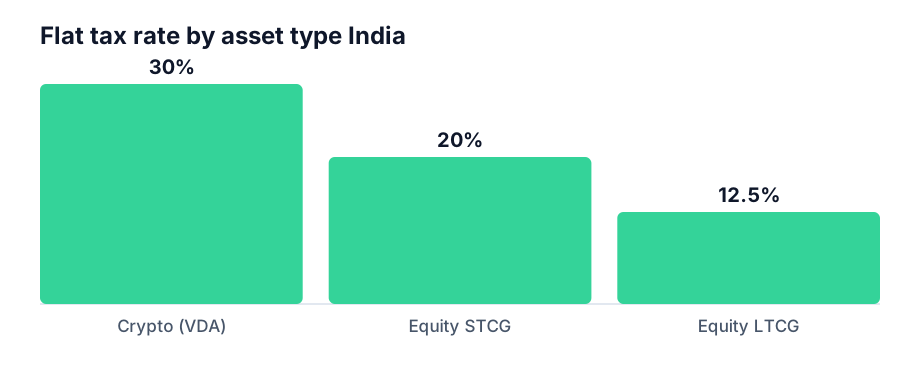
The comparison makes the cost clear. A long-term equity investor pays 12.5% on gains above ₹1.25 lakh. A crypto investor pays 30% on every rupee of gain, regardless of holding period. On a ₹10 lakh gain, that is the difference between paying ₹1,09,375 (equity LTCG) and ₹3,00,000 (crypto) — before surcharge and cess.
For investors weighing where to put their monthly savings, this tax differential matters enormously. You can read more about SIP vs RD for monthly savings to understand how traditional options compare. And if you are exploring equities, our guide to best stocks for beginners in India covers blue-chip picks that benefit from the lower LTCG rate.
For senior citizens, FD interest tax rules for senior citizens are worth understanding since TDS thresholds and rebate limits differ. And if you are working towards a long-term corpus, see how much you need to save monthly for ₹1 crore in 10 years — the math changes significantly depending on whether your returns come from equity (12.5% LTCG) or crypto (30% flat).
How to report crypto gains in your ITR
Crypto gains must be reported in your Income Tax Return under the schedule for "Income from Virtual Digital Assets." Here is how to do it correctly for FY 2026-27 (Assessment Year 2027-28).
Which ITR form to use
- ITR-2: Use if you have salary income, house property income, and crypto gains (capital gains), but no business income
- ITR-3: Use if you trade crypto as a business activity (frequent trading, large volumes, income classified as business profit)
Most retail investors who buy and hold or trade occasionally should use ITR-2 and report crypto under the capital gains schedule as VDA income.
Where to report
In ITR-2, there is a specific section for Virtual Digital Assets under the Capital Gains schedule. You need to enter:
- Date of acquisition
- Date of transfer
- Cost of acquisition
- Sale consideration
- Gain or loss
If you have multiple transactions, report each one separately. Indian exchanges provide transaction reports that you can use to fill this in.
Reporting TDS
The 1% TDS deducted by exchanges appears in your Form 26AS and AIS. Verify these figures match your exchange statements before filing. The TDS goes into the TDS schedule of your ITR and gets credited against your total tax liability.
Filing deadline
The deadline for filing ITR-2 and ITR-3 for FY 2026-27 is 31 July 2027 (for non-audit cases). File on time — late filing triggers a penalty of up to ₹5,000 under Section 234F, plus interest under Section 234A on any unpaid tax.
Common crypto tax filing mistakes to avoid
1. Not reporting at all
Many investors assume that if the exchange already deducted TDS, they do not need to report the gains. This is wrong. TDS is a withholding, not a final tax. You must report the gains in your ITR and pay any balance tax (or claim a refund).
2. Not reporting crypto-to-crypto trades
Swapping Bitcoin for Ethereum is a taxable event. You need to calculate the rupee value of the crypto you received and report the gain or loss, even though no rupees changed hands.
3. Setting off crypto losses against equity gains
This is not permitted. If you do it, the Income Tax Department may reject the set-off during assessment and demand the tax plus interest and penalty.
4. Forgetting to claim TDS refund
If your total tax liability is less than the TDS deducted, you are owed a refund. Many investors do not realise this and leave money on the table. Check your Form 26AS and AIS before filing.
5. Using the wrong ITR form
If you report crypto gains in ITR-1 (Sahaj), which does not have a VDA schedule, the return will be considered defective. Use ITR-2 or ITR-3.
6. Not keeping transaction records
Keep exchange statements, wallet transaction histories, and screenshots of every trade. If the Income Tax Department sends a notice, you need evidence to support your calculations. The burden of proof is on you.
7. Ignoring gifts and airdrops
Receiving crypto as a gift is not taxed at the time of receipt, but selling it later is taxable at 30%. Airdrops and staking rewards are taxable as income from VDA transfer when you sell them. Keep records of when and how you received these tokens.
8. Missing the surcharge calculation
The 30% base rate can become 31.2%, 34.5%, 37.5%, or 42.7% depending on your total income. Calculate the effective rate including surcharge and cess, not just the flat 30%.
Frequently asked questions
Is cryptocurrency legal in India in 2026?
Yes, buying, selling, and holding cryptocurrency is legal in India, but profits are taxed at a flat 30% and 1% TDS applies on transactions.
Can I set off crypto losses against stock market gains?
No, crypto losses can only be set off against crypto gains within the same financial year, and cannot be carried forward to subsequent years.
What is the 1% TDS on crypto transactions?
1% TDS is deducted on crypto transfers by exchanges, and you can claim it as a refund when filing your ITR. The exemption threshold is ₹10,000 per year for most buyers.
Do I pay tax on crypto received as a gift?
Receiving crypto as a gift is not taxed for the recipient, but any profit when you eventually sell that gifted crypto is taxed at the flat 30% rate.
Which ITR form should I use for crypto gains?
Report crypto gains under 'Income from Virtual Digital Assets' in ITR-2 or ITR-3, depending on your other income sources and whether you trade crypto as a business.