Best stocks for beginners in India: 5 blue-chip picks to start with
5 blue-chip stocks perfect for beginners in India. Learn why established companies are safer first picks, how to evaluate them, and when to start.

If you're a new investor in India looking to buy your first stocks, the safest path is to start with best stocks for beginners in India—large, profitable, dividend-paying companies with decades of track record. This article names five specific blue-chip picks with real FY 2025-26 valuations, shows you exactly how to compare them, and walks you through buying your first share, step by step.
Why beginners should start with blue-chip stocks, not penny stocks
The temptation is real: a ₹10 stock that "could go to ₹100" sounds more exciting than a ₹2,000 HDFC Bank share. But that's precisely the trap that wipes out beginner portfolios.
Blue-chip stocks—large-cap companies with market capitalizations above ₹1 lakh crore—are beginner-friendly because they have:
- Predictable earnings: Audited financials, analyst coverage, and decades of revenue history.
- Liquidity: You can buy or sell thousands of shares in seconds without moving the price.
- Dividends: Many pay regular cash returns, giving you income while you wait for the share price to rise.
- Lower volatility: A 10% daily swing is rare; penny stocks routinely swing 30–50% in a day.
Penny stocks and micro-caps are speculative. They lack financial transparency, have thin trading volumes, and are prone to manipulation. As a beginner, your edge is time and compounding, not picking the next 10-bagger. Blue-chips give you that edge.
What makes a stock 'beginner-friendly': dividend yield, PE ratio, and market cap explained
Before you look at the five picks, understand the three metrics that separate a safe stock from a risky one.
Dividend yield: your annual cash payout
Dividend yield = (annual dividend per share ÷ current share price) × 100
If a stock trades at ₹2,000 and pays ₹100 in annual dividends, the yield is 5%. That's cash in your bank account, separate from any price gain. Blue-chips typically yield 2–6%; anything under 1% suggests the company reinvests all profit into growth (common for IT firms), while yields above 8% can signal trouble (the market thinks the price will fall).
PE ratio: what you're paying for earnings
PE ratio = share price ÷ earnings per share (EPS)
A PE of 20 means you're paying ₹20 for every ₹1 of annual profit. Lower PE suggests a "cheaper" valuation; higher PE suggests growth expectations are baked in. For blue-chips, a PE between 15–30 is normal. Anything above 40 is expensive for a beginner; below 12 may indicate the market has lost faith.
Market cap: the size and safety buffer
Market cap = share price × total shares outstanding
Companies above ₹1 lakh crore are household names with regulatory oversight, institutional ownership, and deep pockets to survive downturns. Smaller caps are riskier but can grow faster. Start with companies above ₹50,000 crore.
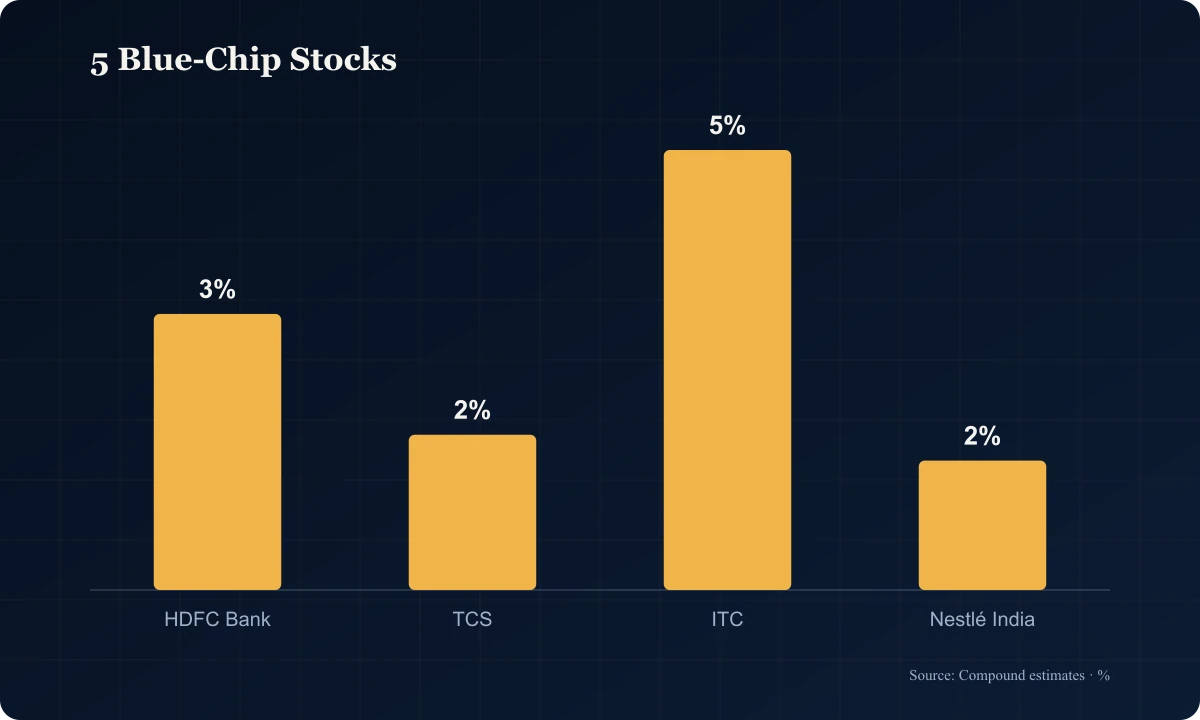
5 blue-chip stocks for beginners: dividend yield and valuation snapshot (FY 2025-26)
Here are five specific picks, with June 2026 data. These are not recommendations—they're examples of what beginner-friendly stocks look like.
| Stock | Sector | Market Cap | Current Price (approx.) | Dividend Yield (FY 2025-26) | PE Ratio | Why it's beginner-friendly |
|---|---|---|---|---|---|---|
| HDFC Bank | Banking | ₹18+ lakh crore | ₹1,950 | 2.8% | 24 | Largest private bank, 25+ years of growth, steady dividend |
| Tata Consultancy Services (TCS) | IT Services | ₹14+ lakh crore | ₹4,100 | 2.1% | 28 | Global brand, ₹1 lakh+ crore revenue, consistent buybacks |
| ITC | FMCG / Diversified | ₹3.5+ lakh crore | ₹485 | 4.2% | 18 | Cigarettes, hotels, agribusiness; high dividend payer |
| Nestlé India | FMCG | ₹2.8+ lakh crore | ₹2,650 | 1.9% | 52 | Premium brand, pricing power, stable margins |
| Bajaj Finance | NBFC | ₹2.2+ lakh crore | ₹7,800 | 0.6% | 32 | Largest NBFC, rapid growth, minimal dividend (reinvests profit) |
Note: All figures are illustrative based on mid-2026 market conditions. Check live prices on NSE/BSE or your broker app before buying.
Why these five?
They span banking, IT, FMCG, and finance—different sectors mean lower correlation, so if one sector struggles, others may hold up. All have market caps above ₹2 lakh crore, meaning institutional ownership and analyst coverage. Three pay dividends above 2%, so you'll see cash returns early on.
How to compare and pick between these 5: a simple three-step checklist
Don't buy all five at once. Use this checklist to pick 2–3 that match your goals.
Step 1: Define your income vs. growth preference
- Need regular cash income? Prioritize ITC (4.2% yield) or HDFC Bank (2.8% yield).
- Want long-term capital appreciation? TCS, Nestlé India, or Bajaj Finance (all growing earnings faster than they pay dividends).
Step 2: Check the PE ratio against your risk appetite
- Conservative: PE under 20. ITC (18) and HDFC Bank (24, borderline) fit here.
- Moderate: PE 20–30. TCS (28) and Bajaj Finance (32, slightly high) are here.
- Growth-focused: Willing to pay higher PE for faster earnings growth. Nestlé India (52) is expensive but has pricing power.
Step 3: Look at recent earnings growth
Use your broker's research tab or Screener.in to check: did earnings per share (EPS) grow 10%+ year-on-year in the last three years? All five should pass this test. If not, skip it.
Worked example: Choosing between HDFC Bank and TCS
You have ₹10,000 to invest. HDFC Bank at ₹1,950 gets you ~5 shares + dividend of ~₹273/year. TCS at ₹4,100 gets you ~2 shares + dividend of ~₹172/year. If you want immediate income, HDFC Bank wins. If you believe IT services will grow faster, TCS wins. Both are safe; the choice is about your timeline and sector conviction.
How to buy your first stock: demat account to placing an order
You cannot buy stocks directly from the NSE or BSE. You need a broker.
Step 1: Open a demat account
A demat (dematerialized) account is a digital locker for your shares. It's free and takes 10 minutes online.
- Via your bank: ICICI Direct, HDFC Securities, Axis Direct. Slower but familiar.
- Via fintech brokers: Zerodha, Upstox, Angel One, Shoonya. Faster and cheaper (₹0–₹500 opening fee).
You'll need: PAN, Aadhaar, a cancelled cheque, and a selfie. The broker links your bank account for fund transfers.
Step 2: Link your bank account and deposit funds
Transfer ₹10,000–₹50,000 to your broker account. Most brokers credit it instantly.
Step 3: Search the stock and place a buy order
Open your broker's app. Search "HDFC" or "TCS". You'll see the live price. Click "Buy", enter the quantity (e.g., 2 shares), and choose order type:
- Market order: Buys at the best available price right now. Fast, but price can slip.
- Limit order: You set a price (e.g., "buy TCS only if it drops to ₹4,050"). Safer, but may not fill if the price doesn't reach your limit.
For beginners, market orders are simpler. Hit "Confirm", enter your 2FA code, and you own the stock in seconds.
Step 4: Check your holdings
Within 2 business days, the shares appear in your demat account. You can now track them, receive dividends, or sell anytime.
How much to invest as a beginner: lumpsum vs. SIP in stocks
You have two approaches: buy once (lumpsum) or buy small amounts regularly (SIP).
| Approach | Amount | Pros | Cons | Best for |
|---|---|---|---|---|
| Lumpsum | ₹10,000–₹50,000 in one shot | Simple, fewer brokerage fees | Risky if you buy at a market peak | If you have cash and can wait 10+ years |
| SIP (Systematic Investment Plan) | ₹500–₹2,000/month for 12+ months | Averages out price swings, forces discipline | Takes longer to build size | If you earn a salary and want to automate |
Beginner recommendation: Start with a ₹10,000 lumpsum into one stock (e.g., HDFC Bank or TCS) to understand the mechanics. Once comfortable, set up a ₹1,000/month SIP into a second stock for 12 months. This way, you learn without over-committing.
Use our SIP calculator to project returns over 10+ years to see how a ₹1,000/month investment compounds. For a detailed comparison, check compare lumpsum vs. SIP investing in stocks.
The ₹1 crore goal
If you're aiming to build serious wealth, our guide on how much to invest monthly to build ₹1 crore shows that a ₹5,000/month SIP into blue-chips can get you there in 15–20 years, assuming 12% annual returns.
Common beginner mistakes to avoid before your first buy
Mistake 1: Chasing hot tips from social media
Your cousin's friend made ₹5 lakh on a penny stock, so you buy it too. By the time you hear about it, the pump-and-dump is over. Stick to names you recognize and can research easily.
Mistake 2: Panic-selling after a 10% dip
Blue-chips fall 10–15% regularly. In 2020, HDFC Bank fell 40% in weeks. If you sold then, you'd have locked in a loss. The ones who held are up 3x since. Ignore short-term noise.
Mistake 3: Over-diversifying with tiny amounts
Buying ₹1,000 each in 10 different stocks is chaos. You can't track them, and brokerage fees eat into returns. Start with 2–3 stocks, ₹5,000+ each.
Mistake 4: Ignoring taxes
Short-term capital gains (under 1 year) are taxed at slab rates (up to 30% for high earners). Long-term gains (over 1 year) are taxed at 20% with indexation benefit. Dividends are taxed at slab rates. Plan ahead, especially if you're a high earner.
Mistake 5: Timing the market
"I'll buy when it falls 20%." It rarely does predictably. The best time to start is now, not when you've "done more research." You learn by investing small amounts, not by waiting.
Track your picks: free tools and apps Indian retail investors use
Once you own stocks, you need to monitor them without obsessing daily.
Your broker's app: Zerodha Kite, Upstox, Angel One. All show live prices, portfolio value, and P&L (profit/loss). Check weekly, not hourly.
Screener.in: Free stock research. Search any stock, see PE ratio, dividend history, earnings growth, and peer comparison. Use this before buying.
Moneycontrol / ET Markets: Free news and stock screeners. Set up price alerts so you're notified if a stock falls 10%.
Excel or Google Sheets: Track your cost price, quantity, and current value. Add a formula to calculate total returns. Many beginners find this more useful than fancy apps.
Calculate historical CAGR: Use our calculate historical CAGR of any stock you're tracking tool to see if your picks have delivered 12%+ annual returns over the last 5–10 years. If not, ask why.
Avoid over-tracking
Checking your portfolio every hour will drive you mad. Set a reminder to review once a month. Blue-chips are boring by design—that's the point. If you're tempted to trade daily, you're not ready for stocks yet.
Frequently asked questions
Can I buy stocks directly or do I need a broker?
You need a broker (stockbroker or app). Open a demat account with a regulated broker like Zerodha, Upstox, or your bank's brokerage arm, then place buy orders through their app or website. The process takes 10 minutes and costs ₹0–₹500.
How much should I invest in my first stock purchase?
Start with ₹5,000–₹15,000 per stock. This is enough to understand the process without over-committing. Many beginners use SIP (systematic investment plan) of ₹500–₹1,000 monthly into 2–3 blue-chips instead. This removes the pressure of timing and builds discipline.
What's the difference between dividend yield and share price growth?
Dividend yield is the annual cash payout as a percentage of share price; growth is the increase in share price itself. Blue-chips offer both—steady dividends plus long-term capital appreciation. For example, if you buy HDFC Bank at ₹1,950 and it pays ₹55/year in dividends, that's a 2.8% yield. If the share price rises to ₹2,100 in a year, that's a 7.7% capital gain. Together, you've made 10.5%.
Is it risky to buy just 5 stocks?
Not if they're blue-chips across different sectors (banking, IT, FMCG, finance). For true diversification, consider a mix of 5–8 stocks or a low-cost index fund instead. A Nifty 50 index fund holds 50 large-caps and costs almost nothing to buy (0.1% annual fee). Many beginners find this simpler than picking individual stocks.
How long should I hold these stocks?
Blue-chips are buy-and-hold investments. Aim for 10+ years. Short-term trading is far riskier for beginners; patience is your edge. Over 10 years, even a stock that grows 10% annually will triple your money. Over 1 year, anything can happen.
Disclaimer
This article is educational content, not investment advice. The stocks mentioned are examples of beginner-friendly blue-chips; they are not recommendations. Always do your own research, check live prices and valuations, and consult a financial advisor before investing. Past performance does not guarantee future returns. Equity markets carry risk of capital loss.