Minimum amount to start SIP in index funds India 2026
Wondering about the minimum amount to start a SIP in index funds in India? Learn the lowest entry points, best funds, and how to begin your SIP in 2026.

If you are new to equity investing, the minimum amount to start SIP in index funds India is surprisingly low — often just ₹100 a month. This guide lists the exact minimum SIP amounts for popular index funds in 2026, walks you through how to begin, and shows how index fund SIPs compare with active funds on cost, tax, and long-term returns.
What is an index fund and why choose SIP mode?
An index fund is a mutual fund that passively tracks a stock market index such as the Nifty 50, Nifty Next 50, or Nifty 500. Instead of a fund manager selecting stocks, the fund simply holds the same stocks in the same proportions as the underlying index. The objective is not to beat the market but to mirror its returns as closely as possible.
The biggest advantage is cost. A typical Nifty 50 index fund direct plan carries an expense ratio of around 0.20 to 0.30 percent per year, compared with 1.5 to 2 percent for many active large-cap funds. Over 20 or 30 years, that gap compounds into a significant difference in your final corpus.
SIP, or Systematic Investment Plan, is a method of investing a fixed amount at regular intervals — usually monthly — through auto-debit from your bank account. You don't need to time the market. You buy more units when prices are low and fewer when prices are high, a mechanism known as rupee cost averaging. For most salaried investors, SIP is the simplest way to build an equity habit without needing a lump sum.
Index funds are especially suited for SIPs because they remove the risk of a fund manager underperforming the benchmark. If you are also exploring direct stock picking alongside passive investing, see our list of best stocks for beginners in India — but for hands-off, low-cost exposure, an index fund SIP is hard to beat.
Minimum amount to start SIP in index funds India
There is no SEBI-mandated minimum for SIP investments. Each asset management company (AMC) sets its own threshold, and these have come down sharply over the years to attract first-time investors.
Here is what you will typically find in 2026:
- Minimum monthly SIP: ₹100 to ₹500 for most index funds
- Minimum lump sum investment: ₹5,000 for most funds (some allow ₹1,000)
- Minimum additional purchase: ₹100 to ₹1,000 depending on the fund
- Minimum number of instalments: Most AMCs require a minimum commitment of 6 months for a SIP, though you can cancel anytime without penalty
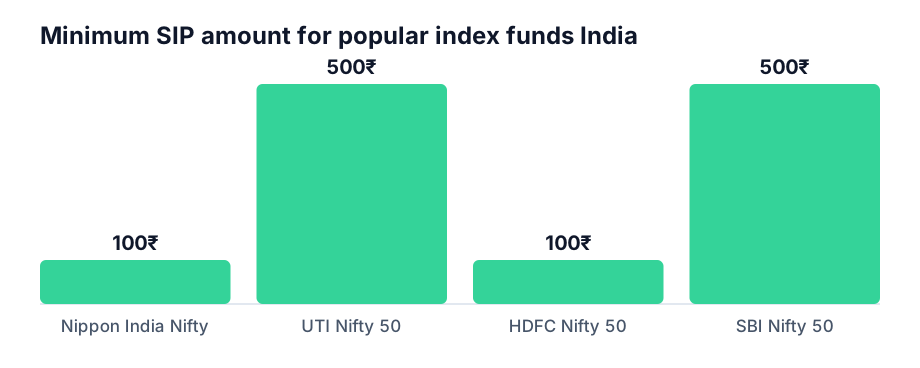
The Nifty 50 index fund minimum investment is among the lowest in the category. Funds like Nippon India Nifty 50 Index Fund and HDFC Index Fund — Nifty 50 Plan allow you to start a SIP with just ₹100 per month. Others like UTI Nifty 50 Index Fund and SBI Nifty 50 Index Fund set the bar at ₹500.
The starting amount matters far less than consistency and periodic step-ups. If you have a specific target in mind, see our breakdown of how much to save monthly for ₹1 crore to understand the math behind long-term wealth creation.
Top index funds with low minimum SIP in 2026
Below is a comparison of popular index funds available to Indian investors in 2026, with their minimum SIP amounts, tracked index, and approximate expense ratios for direct plans. Expense ratios are indicative and change over time — always verify the latest factsheet on the AMC website before investing.
| Fund name | Index tracked | Min. SIP (₹/month) | Min. lump sum (₹) | Expense ratio (direct, approx.) |
|---|---|---|---|---|
| Nippon India Nifty 50 Index Fund | Nifty 50 | 100 | 5,000 | 0.20% |
| HDFC Index Fund — Nifty 50 Plan | Nifty 50 | 100 | 5,000 | 0.20% |
| ICICI Prudential Nifty 50 Index Fund | Nifty 50 | 100 | 5,000 | 0.20% |
| Axis Nifty 50 Index Fund | Nifty 50 | 100 | 5,000 | 0.20% |
| SBI Nifty 50 Index Fund | Nifty 50 | 500 | 5,000 | 0.20% |
| UTI Nifty 50 Index Fund | Nifty 50 | 500 | 5,000 | 0.20% |
| Motilal Oswal Nifty 50 Index Fund | Nifty 50 | 500 | 5,000 | 0.20% |
| Tata Nifty 50 Index Fund | Nifty 50 | 500 | 5,000 | 0.20% |
| Nippon India Nifty Midcap 150 Index Fund | Nifty Midcap 150 | 100 | 5,000 | 0.25% |
| Motilal Oswal Nifty Next 50 Index Fund | Nifty Next 50 | 500 | 5,000 | 0.30% |
A few things to keep in mind when choosing among the best index funds for SIP beginners India:
- Direct plans are cheaper. Always choose the direct plan over the regular plan. The regular plan pays a commission to a distributor, which is deducted from your returns. Over 20 years, the difference can be 0.5 to 1 percent annually — a large sum in absolute terms.
- Tracking error matters. A low expense ratio is of little use if the fund doesn't follow the index closely. Look for funds with a tracking error of less than 0.5 percent.
- AUM size helps. Larger funds tend to have lower tracking error because fixed costs spread over a bigger asset base. Most funds listed above have AUMs exceeding ₹5,000 crore.
- ETF vs index fund. Nifty BeES and other ETFs have even lower expense ratios (around 0.04 to 0.07 percent) but require a demat account and trade like stocks. Index funds are simpler for SIPs because no demat account is needed and the auto-debit happens automatically.
For a first-time investor, a single Nifty 50 index fund SIP is sufficient. If you want broader exposure later, you can add a Nifty Next 50 or a midcap index fund.
How to start your first index fund SIP step-by-step
If you're wondering how to start index fund SIP in India, the process takes about 15 to 20 minutes once your KYC is complete. Here is the step-by-step walkthrough:
1. Complete your KYC
If you have never invested in mutual funds, you need to be KYC-compliant. You can do this online through any AMC website or a KYC Registration Agency (KRA) such as CVL KRA, Karvy, or NSE KRA. You will need your PAN, Aadhaar, and a cancelled cheque or bank statement. The process is mostly paperless using Aadhaar-based OTP verification.
2. Choose a platform
You can invest directly through:
- AMC websites or apps — no intermediary, direct plans only
- Direct mutual fund platforms such as Kuvera, Groww, Paytm Money, Zerodha Coin, or INDmoney
All of these offer direct plans with zero commission. The AMC route means managing multiple logins if you use different fund houses. Aggregator apps give you a single dashboard across AMCs.
3. Pick the fund
For your first SIP, pick a single Nifty 50 index fund direct plan. Don't overthink which one — the top five are nearly identical in performance because they all track the same index. Choose based on minimum SIP amount and expense ratio.
4. Decide the amount and date
Start with an amount you can sustain for at least 3 to 5 years — even ₹500 or ₹1,000 is perfectly fine. Pick a date that falls a few days after your salary credit so your account always has sufficient funds. You can choose any date from the 1st to the 28th of the month.
5. Set up the auto-debit mandate
You will need to complete a one-time NACH (National Automated Clearing House) mandate, usually for ₹1 lakh or more, which authorises your bank to auto-debit the SIP amount. This is done online using net banking or a debit card. The mandate typically takes 5 to 10 working days to activate.
6. Let it run
Once active, the SIP auto-debits every month and buys units at that day's NAV. You can pause, stop, or modify the amount anytime through the platform. There is no penalty for stopping a SIP early.
Minimum SIP amount: index funds vs active mutual funds
On minimum SIP amount alone, index funds and active funds are quite similar. Most active mutual funds also allow SIPs starting at ₹100 or ₹500. The real difference shows up in cost and performance consistency over time.
| Feature | Index fund SIP | Active mutual fund SIP |
|---|---|---|
| Typical minimum SIP | ₹100 to ₹500 | ₹100 to ₹500 |
| Expense ratio (direct plan) | 0.20 to 0.30% | 0.50 to 1.50% |
| Fund manager risk | None | Yes — manager can underperform |
| Long-term consistency | Mirrors the index | Most lag the index over 10+ years |
| Complexity | Very low | Moderate — requires research and periodic review |
According to SPIVA scorecard data, over 70 percent of active large-cap funds in India have underperformed the Nifty 50 over 5- and 10-year periods. This is the core argument for the index fund SIP vs active mutual fund SIP debate: you get market returns at near-zero cost, without betting on a manager's skill.
That said, some investors prefer active funds in the mid- and small-cap segments, where the index is less efficient and skilled managers can add alpha. But for large-cap exposure, passive investing is the clear winner for most beginners.
If you're weighing other monthly savings options, our SIP vs RD comparison for monthly savings breaks down the trade-offs in detail.
Tax on index fund SIP returns explained
Index funds are classified as equity mutual funds for taxation because they hold more than 65 percent of their corpus in domestic equities. The tax rules changed in the Union Budget 2024, and the current rates applicable for FY 2026-27 are as follows:
Long-term capital gains (LTCG)
If you hold units for more than 12 months, gains are classified as long-term. LTCG up to ₹1.25 lakh per financial year is exempt from tax. Gains exceeding ₹1.25 lakh are taxed at 12.5 percent without the benefit of indexation.
Short-term capital gains (STCG)
If you hold units for 12 months or less, gains are short-term and taxed at a flat 20 percent. This rate was increased from 15 percent to 20 percent effective 23 July 2024.
How SIP taxation works in practice
Each SIP instalment is treated as a separate purchase. When you redeem, units are sold on a first-in-first-out (FIFO) basis. So if you have been running a SIP for 3 years and redeem everything, the oldest units (held for more than 1 year) qualify for LTCG treatment, while the most recent units (held for 1 year or less) are taxed as STCG.
Exit load
Most index funds have either no exit load or a minimal one — typically 0.25 percent if you exit within 15 to 30 days of investment. Since SIP units are purchased on different dates, the exit load applies only to units held for less than the specified period. Check the scheme information document for exact terms.
A simplified example
Suppose you invest ₹5,000 per month for 2 years and then redeem everything. Your total invested amount is ₹1,20,000. Let's say the redemption value is ₹1,40,000, giving a total gain of ₹20,000.
- Units from the first 12 months (12 instalments, ₹60,000 invested) are long-term. If their gain is ₹15,000, and your total LTCG for the year is under ₹1.25 lakh, no tax is payable.
- Units from the last 12 months are short-term. If their gain is ₹5,000, STCG tax at 20 percent equals ₹1,000.
Actual gains will depend on the NAV on each purchase date and the redemption date.
Common mistakes beginners make with index fund SIPs
Choosing the regular plan
If you invest through a bank or distributor, you will likely be sold the regular plan, which carries a higher expense ratio (0.7 to 1.2 percent versus 0.2 percent for direct). Over 20 years, this can cost you lakhs of rupees. Always verify you are investing in the direct plan.
Stopping the SIP during market falls
This is the most damaging mistake. Market corrections are exactly when SIPs work best — you buy more units at lower prices. Investors who stopped SIPs during the March 2020 crash or the June 2022 correction missed the subsequent recovery and locked in their losses.
Owning too many index funds
Owning three different Nifty 50 index funds doesn't diversify your portfolio — it just adds clutter. One Nifty 50 fund is enough for large-cap exposure. If you want more, add a Nifty Next 50 or a midcap index fund, but avoid overlap. The same logic applies to direct stocks — see our guide on how many stocks should a beginner hold in India for a framework.
Not stepping up the SIP
Your income rises every year, but most investors keep their SIP amount flat. A 10 percent annual step-up can add 30 to 40 percent to your final corpus over 20 years without any additional effort. Most platforms offer an auto step-up feature at the time of setting up the SIP.
Confusing ETFs with index funds
ETFs trade on the stock exchange and require a demat account. You also need to place a buy order manually each month or set up a separate trading SIP. Index funds auto-debit your bank account and are simpler for most beginners. ETFs are cheaper but require more operational effort.
Checking the portfolio too often
Index fund SIPs are designed to be boring. Checking your portfolio daily creates anxiety and tempts you to time the market. Review once a quarter, or even once a year. The whole point is to let compounding do the heavy lifting.
Ignoring asset allocation
A 100 percent equity portfolio is not suitable for everyone. If you have short-term goals (under 3 years), keep that money in liquid funds or fixed deposits. Index fund SIPs are for goals that are 5 to 10 years or more away.
Frequently asked questions
What is the minimum amount to start a SIP in index funds in India?
You can start a SIP in most index funds in India with as little as ₹100 to ₹500 per month, depending on the fund house. Several Nifty 50 index funds from AMCs like Nippon India, HDFC, and ICICI Prudential allow a minimum SIP of just ₹100.
Can I start an index fund SIP with ₹100 per month?
Yes, several index funds like Nippon India Nifty 50 allow SIPs starting at just ₹100 per month, making them accessible to beginners. You can start with ₹100 and increase the amount later as your income grows.
Are index funds better than active mutual funds for SIP beginners?
Index funds have lower expense ratios and offer broad market exposure, making them a simple and cost-effective choice for SIP beginners in India. Over long periods, most active large-cap funds underperform the Nifty 50, so passive investing gives you a higher probability of market-matching returns.
Is there a lock-in period for index fund SIPs?
No, index fund SIPs have no lock-in period. You can redeem your units anytime, but exit loads may apply if you withdraw within a short period of investing — typically 15 to 30 days. ELSS tax-saving funds are the only equity mutual funds with a lock-in (3 years), and they are not index funds.
How are index fund SIP returns taxed in India?
Index fund returns are taxed as equity mutual funds: 12.5% LTCG on gains over ₹1.25 lakh after one year, and STCG at 20% if sold within one year. Each SIP instalment is taxed separately based on its individual holding period.