SIP vs RD: which is better for monthly savings in India?
SIP vs RD: compare returns, risk, tax treatment and liquidity to choose the right monthly investment for your goals in India.
If you have ₹10,000 left over each month, the default move for most Indian savers is a recurring deposit at the neighbourhood bank. But that habit deserves a harder look, because a SIP vs RD comparison is not just about returns — it is about tax, inflation, time horizon and what you are actually saving for. This piece lays out actual maturity numbers, post-tax math and a concrete rule for when each option wins.
What is SIP and RD: quick definitions
A Recurring Deposit (RD) is a bank or post office product where you commit to depositing a fixed amount every month for a fixed tenure — typically 6 months to 10 years — and the bank pays you a fixed interest rate, compounded quarterly, on your deposits. The maturity amount is known on day one. There is no surprise, no volatility, and no market link.
A Systematic Investment Plan (SIP) is not a product — it is a method. It automates investing a fixed amount every month into a mutual fund, usually an equity or hybrid fund. The returns are not fixed; they depend on how the underlying securities perform. Over long horizons, equity SIPs have delivered 10 to 14 per cent annualised in India, but with real volatility along the way.
So the SIP vs recurring deposit debate is really a debate between a guaranteed-return savings product and a market-linked investing method. They serve different purposes, and treating them as interchangeable is the first mistake.
SIP vs RD returns: actual numbers over 10 years
This is where most comparisons go fuzzy. Let us use real numbers.
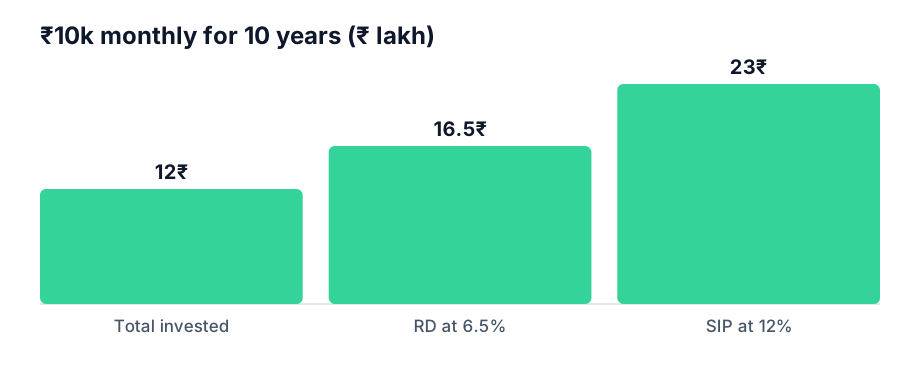
Assume you invest ₹10,000 per month for 10 years — ₹12 lakh of your own money over the period.
RD scenario: Major banks in 2026 offer roughly 6.5 to 7 per cent on RDs. Take 7 per cent as an optimistic case. RD interest is compounded quarterly, which gives an effective annual yield slightly above the headline rate. For a 10-year RD at 7 per cent, the maturity amount works out to approximately ₹17.3 lakh. That is about ₹5.3 lakh of interest on ₹12 lakh of deposits.
SIP scenario: Take a conservative 11 per cent annualised return for an equity mutual fund SIP — below the long-run Nifty 50 TRI average but realistic enough to plan with. Monthly compounding at 11 per cent over 10 years gives a maturity value of approximately ₹22.4 lakh. That is about ₹10.4 lakh of gains on ₹12 lakh invested.
The gap is roughly ₹5.1 lakh in favour of SIP over 10 years, before tax. After tax — which we cover below — the gap widens further, because RD interest is fully slab-taxed while equity mutual fund gains above ₹1.25 lakh per year are taxed at 12.5 per cent.
| Parameter | RD at 7% | Equity SIP at 11% |
|---|---|---|
| Monthly investment | ₹10,000 | ₹10,000 |
| Tenure | 10 years | 10 years |
| Total invested | ₹12,00,000 | ₹12,00,000 |
| Approx. maturity value | ₹17,30,000 | ₹22,40,000 |
| Gains | ₹5,30,000 | ₹10,40,000 |
| Tax on gains | Slab rate (30% if top bracket) | 12.5% on equity gains above ₹1.25L/yr |
| Post-tax value (30% slab) | ~₹15,71,000 | ~₹21,60,000 |
That post-tax gap is nearly ₹5.9 lakh — almost half your total invested capital, lost to the combination of lower returns and higher tax on RD. If you want to understand how much monthly saving actually moves the needle over a decade, see our breakdown on how to save monthly for ₹1 crore in 10 years.
Risk: guaranteed returns vs market volatility
This is the one area where RD has a genuine edge, and it should not be brushed aside.
What RD guarantees
Your principal and interest are fixed. A 7 per cent RD will return exactly what the schedule says, regardless of what the stock market, bond market or economy does. Bank RDs up to ₹5 lakh per depositor per bank are also covered by DICGC deposit insurance, so even a bank failure does not wipe you out above that threshold.
For someone who cannot tolerate a single rupee of nominal loss — a retiree, someone saving for a near-term obligation, or someone simply without the risk appetite — that guarantee has real value.
What SIP does not guarantee
Equity SIP returns are not linear. The same 11 per cent annualised return that shows up in a neat table can arrive via a path where your portfolio is down 15 per cent in year 2, flat in year 4, and then runs up sharply in years 7 to 10. This is why SIP returns vs RD interest is not an apples-to-apples comparison: one is a fixed schedule, the other is an average of volatile yearly outcomes.
The risk in SIPs reduces meaningfully with time. Looking at rolling 10-year periods of the Nifty 50 over the last two decades, the overwhelming majority delivered positive returns, and most delivered double-digit annualised returns. But over 1-year or 2-year windows, negative returns are common. So the relevant question is not "can SIP lose money?" but "can I stay invested long enough for the risk to fade?"
If your answer is no — because you need the money soon, or you will panic-sell during a correction — RD is the more honest choice.
Tax treatment: the hidden cost in RD interest
This is where the SIP or RD which is better question gets answered most sharply, and where most savers underestimate the drag.
How RD interest is taxed
RD interest is added to your total income and taxed at your income tax slab rate — 5, 20 or 30 per cent plus cess and surcharge as applicable. There is no separate RD exemption, and TDS of 10 per cent is deducted once interest in a year crosses ₹40,000 (₹50,000 for senior citizens). You still pay the balance slab tax when you file your return.
For a 30 per cent slab investor, a 7 per cent RD becomes roughly 4.9 per cent post-tax. That is below most credible inflation forecasts for India over a 10-year window. You are not losing money in nominal terms, but you are likely losing purchasing power.
This is the same treatment that applies to FD interest — see our guide on tax on FD and RD interest for the full breakdown, including how senior citizens can claim ₹50,000 deduction under Section 80TTB.
How equity SIP gains are taxed
Equity mutual fund gains held over one year are long-term capital gains, taxed at 12.5 per cent above ₹1.25 lakh per financial year. Gains below ₹1.25 lakh are tax-free. Short-term gains (held under one year) are taxed at 20 per cent.
For a long-tenure SIP, most of your redemption at maturity will be LTCG, and only the amount above ₹1.25 lakh is taxed — at a rate far below the 30 per cent slab. This is why the post-tax SIP returns vs RD interest gap is wider than the pre-tax gap.
If you invest via SIPs in debt mutual funds, the tax treatment is different — gains are added to your income and taxed at your slab rate, same as RD. So the tax advantage described here applies specifically to equity-oriented mutual funds.
Liquidity and flexibility compared
RD: locked in, with penalties
RDs have a fixed tenure. You can break them early, but most banks charge a penalty of 0.5 to 1 per cent on the applicable interest rate, and some pay only the savings account rate for the period the RD was held if you break very early. You also cannot easily change the monthly amount mid-way — you would need to start a new RD.
Loans against RD are available at most banks — typically up to 90 per cent of the RD value, at 1 to 2 per cent above the RD rate — but this is borrowing against your own money, not a substitute for liquidity.
SIP: flexible, but with exit loads and market timing risk
You can stop a SIP any month without penalty — you simply stop the mandate. You can also increase, decrease or pause the SIP amount. Redemption is usually possible within 1 to 3 working days.
The catch is that equity mutual funds may charge an exit load — typically 1 per cent if you redeem within 12 to 15 months of investment. ELSS funds have a mandatory 3-year lock-in. And if you redeem when the market is down, you crystallise a loss — so flexibility is real, but using it at the wrong time is costly.
For liquidity, SIP wins on paper. For predictable access without market-timing risk, RD still has a role.
Who should choose SIP vs RD
Pick RD if:
- Your time horizon is under 3 years. Equity markets are too unpredictable over short windows to risk money you will need soon.
- You are saving for a specific, fixed, near-term goal — a home down payment, a wedding, school fees due next year.
- You are in a low or nil tax slab and the post-tax return is acceptable to you.
- You have zero appetite for seeing your portfolio value drop, even temporarily.
- You already have equity exposure and want a stable, guaranteed sleeve.
Pick SIP if:
- Your time horizon is 5 years or more. The longer you stay invested, the more equity's risk premium works in your favour.
- You are building long-term wealth — retirement, a child's education 10 to 15 years out, or a general financial independence fund.
- You are in the 30 per cent tax slab and care about post-tax, post-inflation returns.
- You can tolerate volatility and will not redeem during a market correction.
- You want to invest in equities but do not want to pick individual stocks. If you do want to own stocks directly, see our best stocks for beginners in India — but most investors are better served starting with a broad-market index fund SIP.
The SIP vs RD decision is not about which is universally better. It is about matching the instrument to the horizon, tax slab and risk tolerance.
Using both: a practical monthly savings split
Most savers do not need to pick one. A reasonable framework for FY 2026-27 is to split your monthly surplus based on time horizon:
- First, build an emergency fund. 3 to 6 months of expenses in a liquid fund or sweep-in FD. This is neither SIP nor RD territory — it is liquidity insurance.
- For goals under 3 years, use RD or liquid funds. The certainty matters more than the return.
- For goals 3 to 5 years out, use a hybrid fund SIP or a mix of RD and short-duration debt funds. You get some equity upside without going all-in.
- For goals 5 years and beyond, use equity SIPs. This is where the compounding advantage of SIP vs recurring deposit becomes large enough to justify the volatility.
A simple example: if you have ₹15,000 per month to save, and you have a wedding coming up in 2 years plus a retirement goal 15 years away, you might put ₹5,000 into a 2-year RD for the wedding and ₹10,000 into an index fund SIP for retirement. That is not hedging — that is correctly matching instruments to horizons.
The mistake to avoid is using RD for everything because it feels safe. Over 10 to 15 years, the post-tax, post-inflation return of a 7 per cent RD for a 30 per cent slab investor is roughly 4.9 per cent nominal — which may not even keep up with 5 to 6 per cent inflation. You are guaranteed to lose purchasing power slowly. That is a real risk, even if it does not show up on any single statement.
Equity SIPs carry a different risk — short-term volatility — but over long horizons that risk fades, and the compounding of 11 to 12 per cent returns in a taxed-favourable structure is the single most reliable wealth-building mechanism available to Indian retail investors.
For more investing and savings guides, see our more investing and savings guides.
Frequently asked questions
Is SIP better than RD?
SIP offers higher potential returns (10-14% historically) but carries market risk; RD gives guaranteed 6-7% returns with zero market risk.
Is RD interest taxable?
Yes, RD interest is fully taxable at your income tax slab rate, just like FD interest — there is no separate exemption.
Can I lose money in SIP?
Yes, SIPs in equity mutual funds can decline in the short term, but have historically delivered positive returns over 5+ year periods.
What is a good RD interest rate in 2026?
Major banks offer 6-7% on RDs in 2026, depending on the tenure and the bank you choose.
Should I choose SIP or RD for 3 years?
For horizons under 3 years, RD is safer; for 5+ years, SIP's higher returns and compounding typically win.