How many stocks should a beginner hold in India? Ideal count
Wondering how many stocks a beginner should hold in India? Learn the ideal portfolio size for diversification, risk control, and steady returns.

If you're wondering how many stocks should a beginner hold in India, the honest answer is that it depends on how much capital you're starting with — not a generic "10 to 15 stocks" rule that gets parroted in every YouTube video. A ₹50,000 portfolio needs a very different structure than a ₹10 lakh one, and getting the count wrong in either direction costs you real money. This guide breaks down the ideal stock count by portfolio size, explains the maths behind diversification, and tells you exactly when to scale up.
Why the number of stocks matters for beginners
When you start buying stocks in India, the number of companies you hold decides two things at the same time: how protected your capital is when one company disappoints, and how much effort it takes to keep track of what you own. Beginners usually focus only on the first part and ignore the second — and that's where the mess begins.
A single stock can fall 20 percent in a week on a bad quarterly result, a management change, or a sector headwind. If that stock is 50 percent of your portfolio, you've lost 10 percent of your total capital on one event. If it's 8 percent of a 12-stock portfolio, you've lost 1.6 percent — annoying, but recoverable.
But the opposite problem is just as real. If you hold 25 stocks with ₹2 lakh, you have roughly ₹8,000 in each position. That's not enough to meaningfully move your portfolio even if one stock doubles, and you now have 25 quarterly results, 25 annual reports, and 25 management updates to track every year. Most beginners give up tracking within six months.
The right number sits between these two extremes, and it shifts as your capital grows. For Indian retail investors in FY 2026-27, with brokerage apps making lump-sum investing easy and zero-cost demat accounts the norm, there's no excuse for getting this basic structure wrong.
How many stocks should a beginner hold in India? The short answer
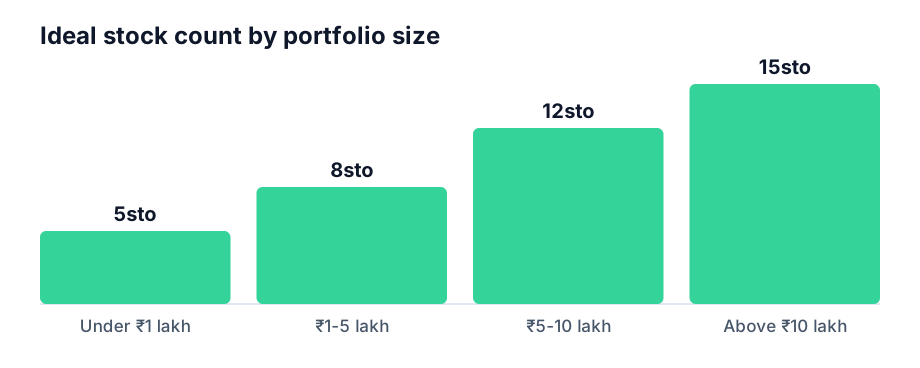
For most beginners in India starting with their first direct equity portfolio, the sweet spot is 5 to 12 stocks, scaled to capital:
- Under ₹1 lakh: 4 to 6 stocks
- ₹1 lakh to ₹3 lakh: 6 to 8 stocks
- ₹3 lakh to ₹5 lakh: 8 to 10 stocks
- ₹5 lakh to ₹10 lakh: 10 to 12 stocks
- Above ₹10 lakh: 12 to 15 stocks (with mutual funds alongside)
Notice that even at the upper end, the number stays under 15. There's a reason for that — studies on the Indian market, including work done on Nifty 500 constituents, show that roughly 85 to 90 percent of the diversification benefit (in terms of reducing portfolio volatility) is captured by holding 12 to 15 well-chosen stocks across sectors. Beyond that, you're adding paperwork, not protection.
If you want a single number to walk away with: start with 5 to 8 stocks if your capital is under ₹2 lakh, and scale up only as your portfolio and your research bandwidth grow. That's the ideal number of stocks for beginners India investors should treat as a starting point, not a permanent ceiling.
Ideal stock count by portfolio size in India
Here's a more specific breakdown that accounts for position size, tracking effort, and the reality that most beginners in India start with small capital.
| Portfolio size | Ideal stock count | Min. position size | Sectors to cover | Suggested approach |
|---|---|---|---|---|
| Under ₹1 lakh | 4 to 6 | ₹15,000 to ₹25,000 | 4 sectors minimum | Large-cap only, one stock per sector |
| ₹1 lakh to ₹3 lakh | 6 to 8 | ₹15,000 to ₹40,000 | 5 to 6 sectors | Large-cap core, 1 to 2 mid-cap |
| ₹3 lakh to ₹5 lakh | 8 to 10 | ₹30,000 to ₹60,000 | 6 to 7 sectors | Large-cap core, 2 mid-cap, 1 small-cap |
| ₹5 lakh to ₹10 lakh | 10 to 12 | ₹50,000 to ₹1 lakh | 7 to 8 sectors | Large-cap, 3 mid-cap, 1 to 2 small-cap |
| Above ₹10 lakh | 12 to 15 | ₹75,000 and above | 8 to 10 sectors | Mix with index funds or active MFs |
The "min. position size" column matters more than people realise. If a position is smaller than ₹15,000, even a 30 percent gain adds only ₹4,500 to your portfolio — barely visible after charges. You end up holding stocks that don't matter to your outcome but still demand attention. This is the beginner stock portfolio size India investors should plan around before opening their first demat account.
For a beginner looking for concrete names to start with, the best stocks for beginners in India list covers large-cap picks that work as a foundation for a 5 to 8 stock portfolio.
Risks of holding too few stocks (concentration risk)
Holding one or two stocks feels clean and bold — until it isn't. The Indian market is full of examples where a darling stock of one cycle becomes the laggard of the next.
Consider these real patterns:
- Yes Bank (2018 to 2020): A widely held retail favourite that fell over 90 percent from its peak. Beginners who held only Yes Bank and one other stock saw their entire portfolio collapse.
- Vodafone Idea: Repeatedly tested retail patience with sharp drawdowns on regulatory and capital-structure news.
- IT stocks in 2022 to 2023: After a massive 2020 to 2021 run, the Nifty IT index corrected sharply on US rate hikes and demand slowdowns. Portfolios loaded only with TCS, Infosys, and Wipro underperformed the broader Nifty 50 for over a year.
The maths of concentration is brutal. If you hold 3 stocks equally and one falls 40 percent, your portfolio is down 13.3 percent. To get back to even, the remaining two stocks need to rise roughly 7.7 percent each — achievable, but not guaranteed. If you hold 8 stocks and one falls 40 percent, you're down 5 percent, and the other seven need to rise just 1.9 percent each to recover.
Concentration also forces emotional decisions. When one stock is dragging your portfolio down by double digits, the temptation to sell at the bottom is enormous. A diversified structure cushions the psychology, not just the numbers.
Risks of holding too many stocks (over-diversification)
The opposite mistake — buying 20, 25, or 30 stocks because "diversification is good" — is more common than beginners admit. Apps like Zerodha, Groww, and Upstox make adding a new stock a 10-second job, so portfolios balloon without strategy.
Here's why over-diversification hurts:
- Diluted winners. If you hold 25 stocks and one doubles, it adds maybe 4 percent to your portfolio if equally weighted. Your best ideas stop mattering.
- Tracking collapse. 25 stocks mean 100 quarterly updates a year. Most beginners stop reading results within two quarters and end up blind to red flags.
- Sector overlap disguised as diversification. Holding HDFC Bank, ICICI Bank, Axis Bank, Kotak Bank, and SBI is not five sectors — it's one. When banking underperforms, all five fall together.
- Higher transaction and tax friction. More stocks mean more churn, more short-term capital gains hits, and more STT and stamp duty leakage, even at zero-brokerage plans.
- Returns converge towards the index. If you hold 40 stocks, you've essentially built a poor man's Nifty 50 — but with worse tax treatment, more effort, and no fund manager doing the work. You're better off buying a Nifty 50 index fund.
A useful rule: if you can't explain in two sentences why you own each stock in your portfolio, you own too many. The minimum stocks for diversification India investors actually need is far lower than what most beginners end up buying.
How to select stocks across sectors for diversification
Diversification is not about counting stocks — it's about counting risk factors. Two stocks in the same sector react to the same macro events. Real stock portfolio diversification for beginners India investors should aim for means spreading exposure across sectors that don't move in lockstep.
For an Indian beginner building a 6 to 10 stock portfolio, a sensible sector spread looks like this:
- Banking or financials (1 to 2 stocks): HDFC Bank, ICICI Bank, or Bajaj Finance. Financials are roughly 30 percent of Nifty 50, so some exposure is unavoidable, but don't overdo it.
- IT services (1 stock): TCS or Infosys. IT moves on US tech spending and the rupee, a different driver from domestic consumption.
- FMCG (1 stock): HUL, ITC, or Nestle. Defensive, slow-moving, cushions the portfolio in downturns.
- Pharma or healthcare (1 stock): Sun Pharma, Cipla, or Dr Reddy's. Independent cycle from banks and IT.
- Auto or manufacturing (1 stock): Maruti, Tata Motors, or Mahindra. Tied to domestic demand and rural recovery.
- Energy or metals (1 stock): Reliance Industries, NTPC, or Tata Steel. Cyclical, gives you commodity exposure.
- Consumer discretionary or retail (1 stock, optional): Titan or Trent. Captures the premium consumption trend in India.
That's 6 to 8 sectors with 6 to 8 stocks — clean, trackable, and genuinely diversified. Avoid the temptation to add a stock just because a friend mentioned it or because it's trending on social media. Every addition should fill a sector gap you've identified.
If picking individual stocks feels overwhelming, SIP vs RD for monthly savings explains why systematic investing in mutual funds often beats ad-hoc stock picking for beginners who don't have the time to research.
When to add more stocks to your portfolio
Your stock count shouldn't be a fixed number forever — it should grow with your capital, your knowledge, and the gaps you spot in your portfolio. But the trigger to add a stock should never be "I have spare cash this month." That's how portfolios become cluttered.
Add a stock when at least one of these is true:
- Your capital has grown meaningfully. If you started with ₹1 lakh in 6 stocks and your portfolio is now ₹4 lakh (through a mix of gains and fresh additions), it's reasonable to move to 8 to 10 stocks to spread risk further.
- A sector is missing. If your 7-stock portfolio has no pharma exposure and you've researched Sun Pharma thoroughly, adding it makes sense.
- A high-conviction opportunity appears. A market correction in 2026 that pushes a quality large-cap to attractive valuations can justify a new position — but only if you've done the work.
- Your risk tolerance has shifted. A salary hike, age change, or new financial goal may justify restructuring.
Don't add a stock when:
- You're bored and want to "do something."
- A tip came from a Telegram group.
- The stock is up 40 percent in a month and you have FOMO.
- You already have 15 stocks and your tracking is already slipping.
For long-term wealth building, the bigger lever isn't how many stocks to hold in portfolio India — it's how much you save and invest every month. The math behind compounding your way to ₹1 crore shows that consistent SIP-style additions, even into a simple 8-stock portfolio, beat frantic portfolio tweaking over 10 to 15 year horizons.
Common mistakes beginners make with stock count
A few patterns show up repeatedly among Indian beginners:
- Starting with 15 stocks on day one. You can't research 15 companies properly in your first month. Start with 5, learn the process, then expand.
- Equal-weighting without thinking. Blindly putting ₹10,000 in each of 10 stocks ignores that some businesses deserve larger positions (HDFC Bank) and others deserve smaller trial positions (a mid-cap you're still studying).
- Confusing mutual fund holdings with stock holdings. If you already own a Nifty 50 index fund, adding 10 of the same stocks directly duplicates exposure. Pick one approach or the other for each portion of your capital.
- Counting sectors as stocks. Five banking stocks is not diversification. It's a bet on one sector with extra steps.
- Ignoring tracking time. Be honest: do you have 4 hours a month to read quarterly results? If not, cap your direct stock holdings at 6 to 8 and put the rest in mutual funds.
- Churning instead of holding. Adding and removing stocks every month generates short-term capital gains tax at 20 percent for equity held under 12 months, as per current rules, and destroys compounding. Build the portfolio, then let it breathe.
- No exit rule. Decide before buying when you'll sell — profit target, fundamental deterioration, or sector thesis breaking. Without this, dead stocks accumulate.
If you're serious about getting the structure right from the start, more investing guides on Compound walk through stock selection, SIP planning, and tax-efficient investing in detail.
Frequently asked questions
Is 5 stocks enough for a beginner in India?
Yes, 5 to 8 stocks across different sectors provide adequate diversification for a beginner with under ₹1 lakh to invest. The key is sector spread, not just the count — 5 stocks in 5 different sectors is far better than 8 stocks all in banking.
Can I hold just 1 or 2 stocks as a beginner?
You can, but it carries high concentration risk. If one stock falls 30 percent, your entire portfolio drops significantly with no cushion. Even seasoned investors rarely hold fewer than 5 stocks, and they have far more research bandwidth than a beginner.
How many stocks is too many for a beginner?
For most beginners, holding more than 12 to 15 stocks becomes hard to track and research. Over-diversification can also dilute your returns — your best ideas stop moving the needle when you own 25 names. If you find yourself holding more than 15 stocks in your first year, you're likely adding without conviction.
Should I add more stocks as my portfolio grows?
Yes, as your capital increases beyond ₹5 lakh, gradually add stocks up to 15 to 20. But never add stocks you haven't researched properly. The trigger to add should be a gap in your sector coverage or a high-conviction opportunity — not just having extra cash sitting in your account.
Is it better to invest in mutual funds instead of picking stocks?
If you cannot track 8 to 12 stocks regularly, mutual funds or SIPs offer instant diversification with less effort and research. A Nifty 50 index fund gives you 50 stocks in one instrument with zero research burden. For most beginners, a combination — mutual funds for the bulk of capital, direct stocks for learning and conviction — works better than going all-in on either.