Is Bitcoin safe for senior citizens in India? Risk & tax guide
Is Bitcoin safe for senior citizens in India? Explore crypto risks, 30% tax rules for FY 2026-27, and safer alternatives like FDs for retirees.

If your grandson has been telling you to buy Bitcoin, or your neighbourhood WhatsApp group is buzzing about crypto returns, you are probably wondering: is Bitcoin safe for senior citizens in India? The honest answer is complicated — Bitcoin is legal to own, but its volatility, tax treatment, and lack of safety nets make it fundamentally different from the fixed deposits and Post Office schemes you have relied on for decades. This guide breaks down the real risks, the 30 percent tax rule, and a practical framework to help you decide whether crypto belongs in your retirement portfolio at all.
What Bitcoin means for senior citizens in India
Bitcoin is a digital asset — there are no physical coins, no issuing government, and no reserve bank backing it. Its price moves purely on what buyers and sellers are willing to pay on global exchanges. For a retail investor in India, you buy Bitcoin through platforms like CoinDCX, WazirX, Zerodha-backed CoinSwitch, or Binance India, holding it in a digital wallet linked to your exchange account.
For most of your investing life, you have dealt with instruments that have clear institutional backing — a bank fixed deposit is a contract with a regulated bank, a government bond is a sovereign promise, and even equity shares are issued by companies regulated by SEBI. Bitcoin does not fit any of these boxes. It exists on a decentralised blockchain network, and its value has swung from around ₹25 lakh per coin in early 2023 to over ₹60 lakh during the 2024 rally, and back down to roughly ₹40–45 lakh levels in 2025. That kind of movement is not how a retiree typically thinks about money.
The question of whether is Bitcoin safe for senior citizens in India is really a question of fit. A 30-year-old salaried investor can absorb a 40 percent drawdown because their monthly salary keeps coming. A 70-year-old retiree living off a corpus cannot. Your financial priorities in retirement are capital preservation, predictable income, and low friction — and Bitcoin scores poorly on all three counts. That does not mean it is a scam or that you are forbidden from owning it. It means the context and sizing matter enormously.
Is Bitcoin safe? Key risks retirees must understand
Price volatility that can break a retirement plan
Bitcoin historically moves 40 to 70 percent in both directions within a single calendar year. In 2024, it went from roughly ₹35 lakh to over ₹65 lakh, then corrected sharply. If you had invested ₹10 lakh at the peak and needed that money for medical expenses six months later, you might have been forced to sell at a 30 percent loss. For someone with a 20-year horizon, a 30 percent dip is a buying opportunity. For someone who needs the money for living expenses, it is a disaster.
No regulatory safety net
Fixed deposits are insured up to ₹5 lakh by DICGC. Mutual funds are regulated by SEBI with strict disclosure norms and custodian safeguards. Bitcoin exchanges in India operate in a grey regulatory zone — they are registered with the Financial Intelligence Unit (FIU-IND) under PMLA rules for anti-money-laundering compliance, but there is no investor protection fund, no deposit insurance, and no ombudsman you can approach if your exchange fails. The 2022 collapse of global exchange FTX, which wiped out retail investors globally, is a cautionary tale.
Cybersecurity and wallet risks
If you hold Bitcoin on an exchange and the exchange is hacked, your recourse is limited. If you hold it in a self-custody hardware wallet, you must manage your seed phrase yourself — a 12 or 24-word password that cannot be recovered if lost. For most seniors, this introduces operational complexity that goes beyond the comfort zone of net banking and demat statements.
Liquidity and conversion friction
While Bitcoin is technically liquid — you can sell it any day — converting it to rupees in your bank account involves exchange withdrawal windows, potential banking delays, and tax deduction at source. This is not the same as breaking an FD and having funds in your account within hours.
Senior citizen crypto investment risks India: a summary
- Volatility risk: 40–70 percent annual price swings are common
- Regulatory risk: No SEBI or RBI protection; tax rules can change
- Platform risk: Exchange hacks or insolvency can wipe out holdings
- Operational risk: Self-custody requires technical comfort most seniors do not have
- Estate planning risk: Passing on crypto to nominees is legally and operationally messy
Crypto tax in India for FY 2026-27: The 30% rule
The single biggest reason seniors should think twice before buying Bitcoin is the tax structure. Since April 2022, India has taxed crypto gains at a flat 30 percent rate, and this continues unchanged into FY 2026-27. The 30% crypto tax rate in India applies to every type of crypto transaction — Bitcoin, Ethereum, stablecoins, NFTs — regardless of whether you held the asset for one day or ten years.
Here is what makes this particularly harsh for retirees:
No benefit of indexation. Unlike real estate or gold, where long-term holdings get indexation benefits to adjust for inflation, Bitcoin gets no such relief. A ₹1 lakh gain on Bitcoin held for five years is taxed at ₹30,000 — same as a gain held for one week.
No adjustment with basic exemption limit. As a senior citizen, your basic exemption limit is ₹3 lakh (₹5 lakh for super seniors above 80). If your total income including crypto falls below this, you pay no tax on normal income. But crypto gains are taxed at 30 percent from the very first rupee — even if your total income is zero. This is a critical point for bitcoin tax for senior citizens FY 2026-27 that most investors miss.
No offset of losses across assets. If you make a profit on Bitcoin and a loss on Ethereum in the same year, you cannot offset them against each other. Each transaction's gain is taxed at 30 percent. Losses can only be carried forward within the same asset class and used against future gains in that class.
1 percent TDS on every transaction. When you sell crypto worth more than ₹10,000, the exchange deducts 1 percent TDS before crediting the proceeds. You can claim this TDS back when filing your income tax return, but it locks up your cash flow until refund time — an annoying friction for retirees who value liquidity.
Surcharge and cess apply on top. The 30 percent is the base rate. If your total income exceeds ₹50 lakh, surcharge of 10 to 37 percent applies, plus a 4 percent health and education cess. For a high-income retiree, the effective crypto tax rate can cross 35 percent.
Bitcoin vs Fixed Deposit for seniors: a direct comparison
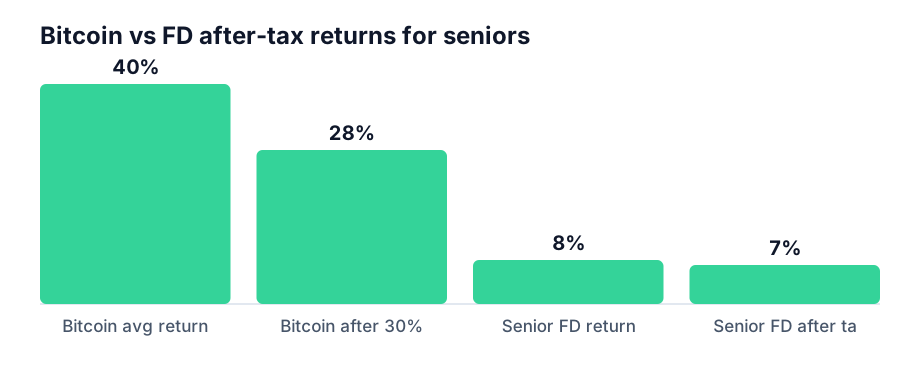
Let us get concrete. The table below compares a ₹10 lakh investment in Bitcoin versus a senior citizen fixed deposit over a one-year horizon, using realistic 2026 numbers.
| Feature | Bitcoin | Senior Citizen FD (5-year) |
|---|---|---|
| Typical annual return (2026) | Negative 40 percent to positive 80 percent (unpredictable) | 7.0 to 7.75 percent (guaranteed) |
| Tax on gains | Flat 30 percent plus surcharge and cess | Taxed at your slab rate; 80TTB exemption up to ₹50,000 |
| Safety of principal | No guarantee; can fall 50 percent or more | DICGC insured up to ₹5 lakh; bank default risk minimal |
| Liquidity | Sell anytime, but 1 percent TDS and withdrawal delays | Break anytime with small penalty (0.5 to 1 percent interest cut) |
| Regulatory protection | FIU-IND registration only; no investor protection | RBI-regulated; DICGC insured; Banking Ombudsman |
| Operational complexity | Wallets, keys, exchange accounts, cyber risk | Net banking or branch visit; familiar process |
| Suitability for retiree income needs | Poor — unpredictable returns disrupt cash flow | High — predictable interest for monthly expenses |
The comparison is stark. A senior citizen FD at 7.5 percent gives you ₹75,000 per year on ₹10 lakh — predictable, taxable at your slab rate, and shielded by the Section 80TTB tax exemption limits up to ₹50,000 of interest income. Bitcoin in a good year might give you ₹3 lakh in gains, but in a bad year it might wipe out ₹4 lakh of your capital. For a retiree drawing down a corpus, the sequence-of-returns risk is devastating — if a bad year hits early in retirement, you may never recover.
The FD interest tax rules for senior citizens are also gentler than crypto tax. If your total income is below ₹3 lakh and your FD interest is say ₹60,000, you pay tax only on ₹10,000 (after 80TTB) at your slab rate — which is zero if income is below the exemption limit. With crypto, you pay 30 percent from the first rupee regardless.
How much of a retirement corpus should go into crypto?
If after understanding the risks and tax burden you still want exposure, the right answer is: very little. Most financial planners in India who are open to crypto recommend a maximum of 1 to 2 percent of total investible assets for retail investors with stable incomes. For retirees, that ceiling should be even lower — think 0.5 to 1 percent, and only if your core income needs are fully met by traditional instruments.
Let us say you have a retirement corpus of ₹1 crore that you built for building a retirement corpus targeting ₹50,000 monthly income. A 1 percent allocation means ₹1 lakh in Bitcoin. Here is how that plays out:
- Best case (Bitcoin doubles in a year): Your ₹1 lakh becomes ₹2 lakh. After 30 percent tax on the ₹1 lakh gain, you have ₹1.7 lakh. You gained ₹70,000 post-tax — meaningful but not life-changing on a ₹1 crore corpus.
- Worst case (Bitcoin drops 50 percent): Your ₹1 lakh becomes ₹50,000. You lost ₹50,000 — painful but survivable because 99 percent of your corpus is still in FDs, bonds, and mutual funds.
- Catastrophic case (Bitcoin drops 50 percent and you need the money urgently): You are forced to sell at a loss, realising a permanent capital erosion that you cannot recover from.
The point of limiting exposure to under 1 percent is that even a total loss does not derail your retirement. You are not betting your monthly expenses on Bitcoin — you are satisfying curiosity or making a small speculative bet with money you can genuinely afford to lose.
A practical checklist before you invest anything
- Are your next 5 years of living expenses covered? Monthly income from FDs, SCSS, PMVVY, or pension should comfortably meet your needs.
- Is your emergency fund in place? At least 12 to 18 months of expenses in liquid instruments, separate from your main corpus.
- Is your health insurance adequate? A senior citizen health plan with at least ₹10 lakh cover, plus a buffer for copayments and exclusions. Review your term insurance needs for seniors above 60 if you still have dependents.
- Are your gold and equity allocations settled? Do not add crypto to your portfolio until your asset allocation across debt, equity, and gold is deliberate and stable.
- Is the amount you plan to invest in Bitcoin money you can write off entirely? If the answer is no, do not invest.
Safest way to explore crypto for curious seniors
If you have read this far and still want to dip your toes in, here is the most conservative path forward. This is not investment advice — it is a risk-management framework for seniors who have decided they want exposure anyway.
Use a FIU-registered Indian exchange only
Stick to CoinDCX, WazirX, CoinSwitch, or Bitbns — all are registered with FIU-IND. Avoid offshore exchanges like Binance's global entity unless you understand the legal and tax complications. Indian exchanges auto-deduct 1 percent TDS and provide transaction reports that make tax filing easier.
Use SIP mode, not lump sum
Most Indian exchanges offer systematic investment plans for Bitcoin — you can invest a fixed amount weekly or monthly. If you must buy, do it over 6 to 12 months rather than all at once. This reduces the risk of buying at a local price peak.
Hold on the exchange initially
Self-custody wallets like Ledger or Trezor are technically complex and a single mistake can wipe out your holdings. For a first-time senior investor, holding on a FIU-registered exchange is the lesser evil. Once your holding exceeds ₹2 to 3 lakh and you are comfortable, consider moving to a hardware wallet with family help.
Document everything for your nominee
Crypto holdings are easy to lose track of after death. Maintain a sealed document with your spouse or children that lists: exchange names, registered email IDs, passwords in a password manager, and instructions on how to access and sell. Without this, your crypto may effectively be lost when you are gone.
Never borrow to invest in crypto
This should go without saying, but some seniors have been tempted to break FDs prematurely or take gold loans to invest in crypto during bull runs. Do not. The interest cost on a gold loan (typically 9 to 12 percent) plus the 30 percent tax on gains means Bitcoin needs to return at least 15 percent just for you to break even — and that is before accounting for its downside risk.
Alternatives: Stable income and tax-saving options for retirees
If Bitcoin sounds too risky after this analysis, that is a rational conclusion. Here are the traditional instruments that serve retirees better on safety, income predictability, and tax efficiency.
Senior Citizen Savings Scheme (SCSS)
- Current interest rate: 8.2 percent per annum (Q1 FY 2026-27)
- Tenure: 5 years, extendable by 3 years
- Maximum investment: ₹30 lakh per person
- Tax: Interest taxed at slab rate; qualifies for 80C deduction on investment up to ₹1.5 lakh
- Safety: Sovereign backed, the highest safety tier available
Pradhan Mantri Vaya Vandana Yojana (PMVVY)
- Current interest rate: 7.4 percent per annum (payable monthly)
- Tenure: 10 years
- Maximum investment: ₹15 lakh per person
- Tax: Interest taxed at slab rate; no 80C benefit
- Safety: Backed by LIC and effectively sovereign
Bank and Post Office fixed deposits
- Senior citizen rates: 7.0 to 7.75 percent (varies by bank and tenure)
- DICGC insurance: Up to ₹5 lakh per depositor per bank
- Tax: Interest taxed at slab rate; 80TTB exemption up to ₹50,000
- Liquidity: Can break with minor penalty
Debt mutual funds
- Returns: 6 to 7.5 percent (varies by fund and duration)
- Tax: Gains taxed at slab rate regardless of holding period (post April 2023 changes)
- Liquidity: Redemption in 1 to 2 working days
- Risk: Low to moderate; interest rate risk exists
Monthly Income Scheme (MIS) at Post Office
- Current interest rate: 7.4 percent per annum (payable monthly)
- Tenure: 5 years
- Maximum investment: ₹9 lakh (single), ₹15 lakh (joint)
- Safety: Sovereign backed
For the equity portion of your portfolio, large-cap mutual funds and index funds remain the most tax-efficient way to get long-term growth. Equity gains held over one year are taxed at 12.5 percent for gains above ₹1.25 lakh per year — far gentler than the 30 percent crypto rate, and with the benefit of long-term compounding.
Frequently asked questions
Can senior citizens invest in Bitcoin legally in India?
Yes, crypto trading is legal in India for all adults, but gains are taxed at a flat 30 percent rate with no benefit of indexation or basic exemption limit adjustment. You can buy, hold, and sell Bitcoin through FIU-IND registered exchanges like CoinDCX, WazirX, or CoinSwitch without legal barriers — but the tax and risk characteristics make it unsuitable as a core retirement holding.
Is crypto income tax-free up to the basic exemption limit for seniors?
No, the 30 percent crypto tax applies regardless of your total income and cannot be offset by the senior citizen basic exemption limit of ₹3 lakh. Even if your total income including crypto gains is below the exemption threshold, crypto gains are taxed at 30 percent from the first rupee. This is a fundamental difference from FD interest or equity gains, which respect the basic exemption limit.
What is the TDS rate on crypto transactions for senior citizens?
A 1 percent TDS is deducted on every crypto transaction exceeding ₹10,000, applicable equally to senior citizens and all other investors. The TDS is credited against your PAN and can be claimed as a refund when filing your income tax return, but it locks up cash flow until then. For retirees managing monthly cash flows, this is an important practical friction to account for.
Are fixed deposits safer than Bitcoin for retirees?
Yes, bank FDs are insured up to ₹5 lakh by DICGC and offer guaranteed returns, making them far safer than Bitcoin for capital preservation in retirement. FDs also benefit from Section 80TTB tax exemption limits on up to ₹50,000 of interest income, and interest is taxed at your slab rate rather than a flat 30 percent. For a retiree whose priority is income predictability and capital safety, FDs, SCSS, and PMVVY remain the appropriate core holdings — not Bitcoin.