Term insurance cover for senior citizens above 60: how much?
Can senior citizens above 60 buy term insurance? How much cover do you need, and what does it cost in 2026? A practical guide for Indian savers.
Term insurance for senior citizens above 60 is widely believed to be unavailable — but that's a myth. The real challenge isn't whether you can buy it; it's figuring out how much cover actually makes sense when you're retired, and whether the premium justifies the protection. This guide shows you which insurers still sell policies to 60+ applicants, what cover amount fits your stage of life, and what you'll actually pay in 2026.
Why term insurance changes after age 60 — and why most seniors skip it
Term insurance is designed for income earners with dependents. By 60, most Indians have stopped earning, downsized dependents, and accumulated some savings. Insurers see this age bracket as higher-risk: health complications rise sharply, claims frequency increases, and the traditional "protection gap" that term insurance plugs has narrowed.
But that logic misses a critical point: not all 60-year-olds are the same. A retired couple with an adult child still in education, or a widowed parent supporting grandchildren, faces real financial risk if the earning spouse or parent dies. A debt-free retiree with ₹1 crore in fixed deposits faces none.
Most seniors skip term insurance because they assume it's closed to them after 60. Others buy endowment or whole-life policies instead — which are expensive, poorly suited to retirement, and often sold by agents chasing commissions rather than client needs.
Can you still buy term insurance above 60? Eligibility and age limits in 2026
Yes, but with strict limits. Most major Indian insurers cap new term policy sales at age 60 or 65. A handful extend to 70–75 for high-net-worth clients or existing customers buying additional cover.
Here's the 2026 landscape:
| Insurer | Max entry age (new policy) | Max entry age (existing customer) | Notes |
|---|---|---|---|
| HDFC Life | 65 | 75 | Requires full medical underwriting above 60 |
| ICICI Prudential | 60 | 70 | Select plans only above 60 |
| SBI Life | 65 | 75 | Premium loading applies |
| Bajaj Allianz | 60 | 65 | Limited cover options |
| Max Life | 65 | 70 | Health-based eligibility |
| Aditya Birla Sun Life | 60 | 65 | Restricted product range |
Key point: If you're 62 and already hold a term policy, you may be able to buy additional cover from the same insurer up to age 70–75. If you're buying for the first time at 62, your options narrow to age 65 insurers, and only if you pass medical screening.
How much term cover do you actually need as a senior citizen?
This is where most financial advice goes wrong. A 60-year-old doesn't need the same cover as a 35-year-old with a 25-year mortgage and two kids in school.
The right formula for seniors:
Cover = Outstanding debts + Final expenses + Spousal/dependent living gap
Breaking it down:
- Outstanding debts: If you have a home loan, personal loan, or credit card dues, cover should be at least enough to clear them. A typical ₹30 lakh home loan balance at 60 means you need at least ₹30 lakh in cover.
- Final expenses: Funeral, medical bills, legal costs. Assume ₹3–5 lakh in 2026.
- Spousal/dependent living gap: If your spouse is 55 and will live another 30 years, and needs ₹50,000/month (₹6 lakh/year) beyond her own income or pension, cover should provide 3–5 years of that gap = ₹18–30 lakh. (Don't overestimate; she'll have her own income, investments, and pension.)
Worked example:
Rajesh is 62, retired with a ₹25 lakh home loan balance, ₹4 lakh in medical/funeral costs assumed, and a spouse (58) who earns ₹20,000/month but will need ₹40,000/month if he dies (₹20,000 gap × 12 months × 4 years = ₹9.6 lakh).
Recommended cover: ₹25 + 4 + 10 = ₹39 lakh. He rounds up to ₹40 lakh for simplicity.
Most senior citizens need ₹25–50 lakh in cover. A few with multiple dependents or large debts may go to ₹75 lakh. Buying ₹1 crore at 65 is overkill and wastes premium money.
Don't confuse cover with income replacement
At 60, you're not replacing 20 years of lost income. You're protecting your spouse and dependents from a sudden financial shock. That's a much smaller number.
Term insurance premium costs for 60+ in India — real examples
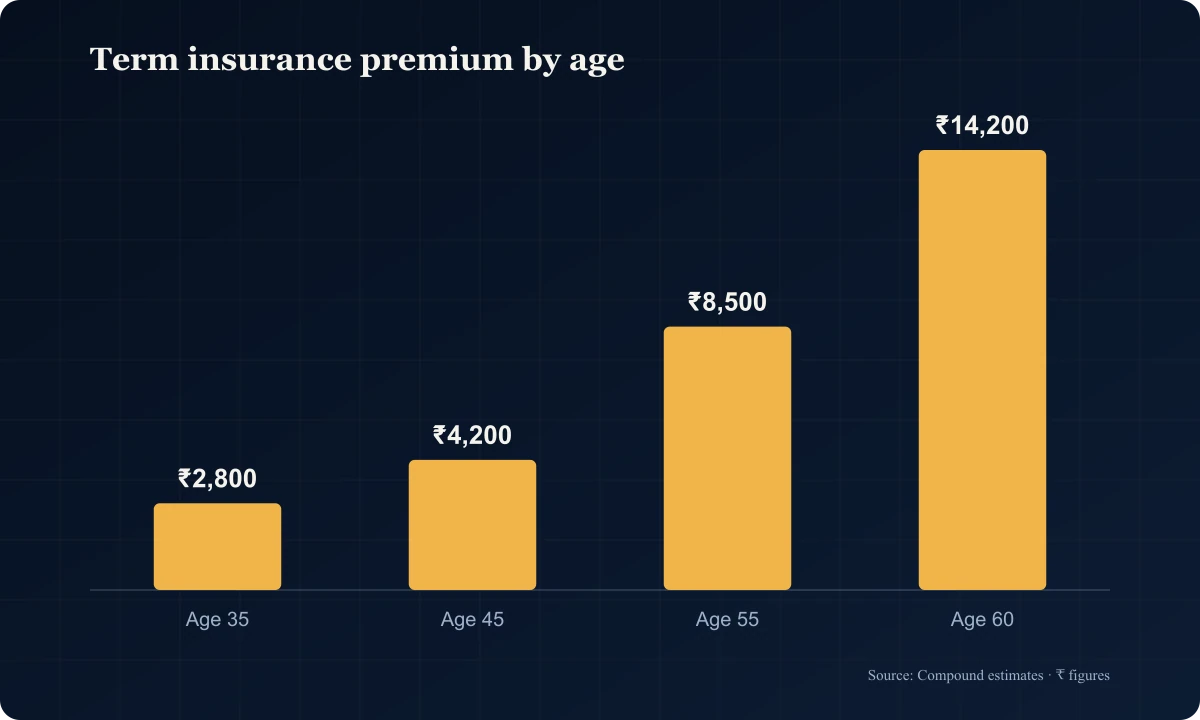
Premiums jump steeply after 60. Here's what you'd actually pay in 2026 for a 20-year term policy (non-smoker, standard health):
| Age | Cover (₹ lakh) | Annual premium (₹) | Monthly cost (₹) |
|---|---|---|---|
| 50 | 50 | 12,000–15,000 | 1,000–1,250 |
| 60 | 50 | 35,000–45,000 | 2,900–3,750 |
| 65 | 50 | 65,000–85,000 | 5,400–7,100 |
| 60 | 25 | 18,000–22,000 | 1,500–1,850 |
| 65 | 25 | 32,000–42,000 | 2,700–3,500 |
Why the jump?
Mortality risk doubles roughly every 8 years after 50. A 60-year-old has a 0.5–0.7% annual mortality risk; a 65-year-old has 0.9–1.2%. Insurers price for that risk directly.
Real scenario:
Meera, 63, non-smoker, wants ₹35 lakh cover for 20 years. She'll pay approximately ₹42,000–52,000 per year, or ₹3,500–4,300 per month. If she waits until 65, the same cover will cost ₹65,000–75,000/year.
This is why buying early — even if you're 60 — saves money. The premium is locked in at your entry age for the full 20 years.
Policy term matters
A 20-year term at 60 expires at 80 (when you likely won't need it). A 10-year term at 60 expires at 70 and costs roughly 40–50% less. If your spouse will be financially independent by 70, a 10-year term is smarter.
Health underwriting and medical tests for older applicants
Term insurance for seniors isn't just about age; it's about health. Insurers will scrutinize your medical history far more than they would for a 40-year-old.
What to expect:
- Cover under ₹25 lakh: Basic health declaration form, no medical tests. Decision in 2–3 days.
- Cover ₹25–50 lakh: Blood test (glucose, lipid profile), urine test, BP check. Takes 5–7 days.
- Cover above ₹50 lakh: Add ECG, sometimes an ultrasound or specialist consultation. Takes 10–14 days.
Pre-existing conditions: If you have diabetes, hypertension, or heart disease, you'll face:
- Premium loading (20–50% higher than standard rates)
- Possible exclusions (e.g., "death from cardiac causes not covered in first 2 years")
- Stricter underwriting — some insurers may decline outright
Disclosure is critical. If you hide a condition and die within 2 years, the insurer can reject the claim entirely under the contestability clause. After 2 years, most policies can't be contested, even for non-disclosure.
Term vs endowment vs whole-life: what makes sense for retirees
At 60+, you'll see agents push endowment and whole-life policies. Here's why they're wrong for most retirees:
| Product | Term | Endowment | Whole-life |
|---|---|---|---|
| Cover | ₹25–100 lakh | ₹10–50 lakh | ₹10–50 lakh |
| Premium (₹50L cover, age 60) | ₹40,000/year | ₹2,50,000/year | ₹1,80,000/year |
| Maturity benefit | None | Full cover returned | None |
| Death benefit | ₹50 lakh | ₹50 lakh | ₹50 lakh |
| Best for | Pure protection, limited budget | Forced savings (bad idea) | Legacy/estate planning |
Why term wins for most seniors:
You're on a fixed income. A ₹40,000/year term premium is manageable; a ₹2,50,000/year endowment isn't. Term gives you the same death benefit at 1/6th the cost. Use the savings to boost your FD interest or emergency fund instead.
When whole-life makes sense:
If you have ₹50 lakh+ in liquid savings and want to leave a tax-free legacy to heirs (life insurance proceeds aren't taxed), a smaller whole-life policy (₹25–50 lakh) can work. But it's optional, not essential.
Common reasons senior citizens are rejected — and how to fix them
Reason 1: Undisclosed pre-existing illness
You apply for term cover and forget to mention your diabetes diagnosis from 5 years ago. Insurer discovers it during underwriting and declines. Fix: Disclose everything. Disclosure + premium loading is better than rejection.
Reason 2: Smoking status misreported
You quit smoking 3 years ago but mark "never smoked." Insurer finds evidence otherwise. Fix: If you quit under 1 year ago, disclose it as a current smoker. After 1 year, you can claim non-smoker status (some insurers require a doctor's letter).
Reason 3: Age at application exceeds insurer's limit
You're 66 and apply to an insurer with a 65-year age cap. Automatic rejection. Fix: Check the insurer's age limits before applying. If you're an existing customer, ask about additional cover under higher age limits.
Reason 4: Medical test results flag concern
Your BP is 160/100, or lipid profile shows high cholesterol. Insurer asks for specialist clearance. Fix: Get a health check-up 2–3 weeks before applying. Control BP with medication if needed. A clean report speeds approval.
Reason 5: Inconsistent application
You claim ₹40 lakh cover but your income/assets don't justify it. Insurer suspects insurance fraud. Fix: Align cover with realistic need. Provide documents (salary slips, bank statements, property papers) if asked.
How to buy term insurance above 60: step-by-step
Step 1: Calculate your actual need
Use the formula above. Don't buy on emotion or agent recommendation.
Step 2: Check your eligibility
Visit 3–4 insurer websites. Note their max entry age for new policies. If you're 62 and want cover, stick to age-65 insurers.
Step 3: Get a health check-up
Before applying, visit your doctor. Get BP, glucose, lipid profile checked. Fix any glaring issues (high BP, weight). A clean report speeds underwriting.
Step 4: Compare quotes
Use online aggregators (PolicyBazaar, Coverfox, Digit) to get quotes in 5 minutes. Compare premium, exclusions, and claim settlement ratio. Don't just pick the cheapest.
Step 5: Apply online or via agent
Online is faster and cheaper (no agent commission markup). If you have complex health issues, an agent who knows underwriters helps.
Step 6: Submit documents
Health declaration form, ID proof, address proof, income proof (if needed). Medical tests will be scheduled if required.
Step 7: Underwriting and approval
Typically 5–14 days. Insurer may ask follow-up questions. Answer promptly.
Step 8: Policy issuance
Once approved, your policy document arrives. Premium is deducted from your bank account monthly/quarterly/annually.
Avoid these mistakes
- Don't lie about health or smoking status. Rejection or claim denial isn't worth the risk.
- Don't buy more cover than you need. A ₹1 crore policy at 65 is expensive and unnecessary for most.
- Don't delay. Every year you wait, premiums rise sharply. If you're 60 and eligible, buy now.
Frequently asked questions
Can a 65-year-old buy term insurance in India?
Yes, but with limits. Most insurers cap new term policies at age 60–65; a few extend to 75 for existing customers or high medical scores. Premiums rise sharply after 60 due to health risk. A 65-year-old will pay 50–100% more than a 60-year-old for the same cover.
How much term insurance cover should a 60+ year old have?
₹25–50 lakh is typical — enough to cover outstanding debts, funeral costs, and 3–5 years of spousal living expenses. Self-protection is less critical; family protection is the goal. Use the formula: outstanding debts + final expenses + spousal living gap. A retiree with no dependents and ₹50 lakh in savings may need only ₹10 lakh for end-of-life costs.
Is term insurance worth buying at 60 if I'm already retired?
Only if you have dependents, unpaid loans, or want to leave a lump sum to heirs. If you're debt-free with savings, a smaller policy (₹10–25 lakh) for legacy or end-of-life costs may suffice. If you're debt-free, have no dependents, and ample savings, term insurance is optional. Consider your spouse's financial independence first.
What medical tests do senior citizens need for term insurance approval?
For cover above ₹50 lakh, expect blood/urine tests, BP check, and sometimes an ECG or lipid profile. Older applicants with pre-existing conditions (diabetes, hypertension) face stricter underwriting. For cover under ₹25 lakh, most insurers skip medical tests entirely and rely on a health declaration form.
Can I claim term insurance if I die from a pre-existing illness within 2 years?
Most policies have a 12-month contestability period. Deaths from disclosed pre-existing conditions are usually covered after that; undisclosed ones may lead to rejection of the claim. Always disclose pre-existing conditions in your application. After the contestability period ends, the insurer can't reject a claim based on non-disclosure.
Disclaimer
This is educational content, not investment or insurance advice. Term insurance suitability depends on your health, dependents, debts, and financial goals. Consult a qualified financial advisor or insurance agent before buying. Policy terms, premiums, and eligibility limits vary by insurer and change over time. Verify current details directly with insurers in 2026. This article reflects FY 2025-26 tax rules and 2026 market conditions.